
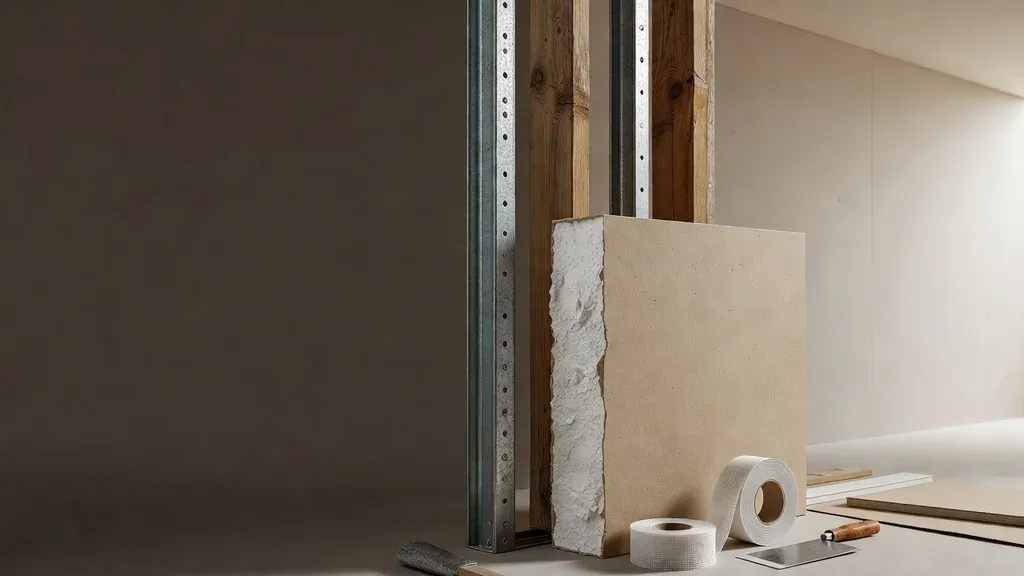
Drywall is the common name for factory-made gypsum panels used to build walls, ceilings, partitions, soffits, and many specialized interior assemblies. The sheet is only the starting point. Framing, fasteners, tape, compound, corners, texture, primer, paint, and project-specific details turn separate panels into a finished plane.
Understanding that system clears up a lot of bad advice. A thicker sheet is not automatically fire-rated. A green or purple face is not automatically approved inside a shower. More screws do not repair unsupported framing. A perfect patch can still show when texture, primer, sheen, or side lighting changes across the surface.
A Short History of Gypsum Board
Gypsum plaster has a much longer history than modern drywall. The shift toward panelized construction happened when manufacturers placed a gypsum-based layer between sheets of paper so builders could install large, consistent boards instead of applying multiple wet plaster coats over lath.
The Gypsum Association describes Sackett Board, developed around the beginning of the twentieth century, as a predecessor to drywall. Early boards used layers of felt paper and gypsum. Manufacturing, facings, edges, cores, dimensions, and installation standards changed over time as panel construction became common.
Single-family builders adopted gypsum wallboard widely during the housing growth after World War II because it reduced the time and labor required to enclose and finish interiors. Today, gypsum panels are used in homes, offices, restaurants, institutions, commercial buildings, and many tested fire- or sound-control assemblies.
Professional note: The age or color of a panel does not identify every property that matters. For repair, verify thickness, backing, framing, exposure, assembly requirements, and finish rather than guessing from the face alone.
What a Drywall Panel Contains
Gypsum is a mineral containing chemically combined water. In common wallboard, a gypsum core is formed into a continuous panel and faced, cut, and dried at the factory. The U.S. Geological Survey reports that wallboard for homes, offices, and commercial buildings is a major use of gypsum in the United States.
Specialty panels can change the core, facing, additives, density, or performance characteristics.
| Panel family | Common purpose | What still needs verification |
|---|---|---|
| Regular gypsum board | Typical interior walls and ceilings | Thickness, framing spacing, ceiling limits, finish |
| Type X or enhanced fire panels | Components in listed fire-resistance assemblies | Complete tested design, layers, fasteners, framing, joints |
| Mold or moisture-resistant panels | Selected interior humidity or moisture-prone locations | Product limits, water source, direct-wet approval, finish system |
| Fiberglass-faced panels | Selected interior or exterior assembly roles | Exact product, exposure, joint treatment, coating |
| High-impact or abuse-resistant panels | Corridors, schools, commercial or demanding areas | Required impact level, framing, fasteners, finish |
| Sound-control panels | Components in acoustic assemblies | Complete wall design, sealing, insulation, penetrations, flanking paths |
| Flexible or thin panels | Curves, laminations, or repair conditions | Layering, framing radius, support, final thickness |
The panel label and manufacturer literature matter. So do plans, specifications, code requirements, and tested assembly details.
The Parts of a Finished Drywall System
A flat wall or ceiling is built through a sequence:
- Framing or an existing substrate provides a straight, supported base.
- Panel type and thickness match the location and required assembly.
- Layout controls butt joints, openings, corners, and unsupported edges.
- Fasteners hold the board without breaking the facing.
- Tape reinforces joints and inside corners.
- Compound fills, embeds, and widens transitions across multiple coats.
- Beads or trims form and protect exposed corners and edges.
- Sanding and inspection correct ridges without damaging paper or tape.
- Texture, when used, becomes part of the surface profile.
- Primer and paint control porosity, color, and sheen across the plane.
The gypsum board installation guide covers the early sequence. The smooth mudding guide and sanding mistakes guide explain why the joint build matters as much as the sheet.
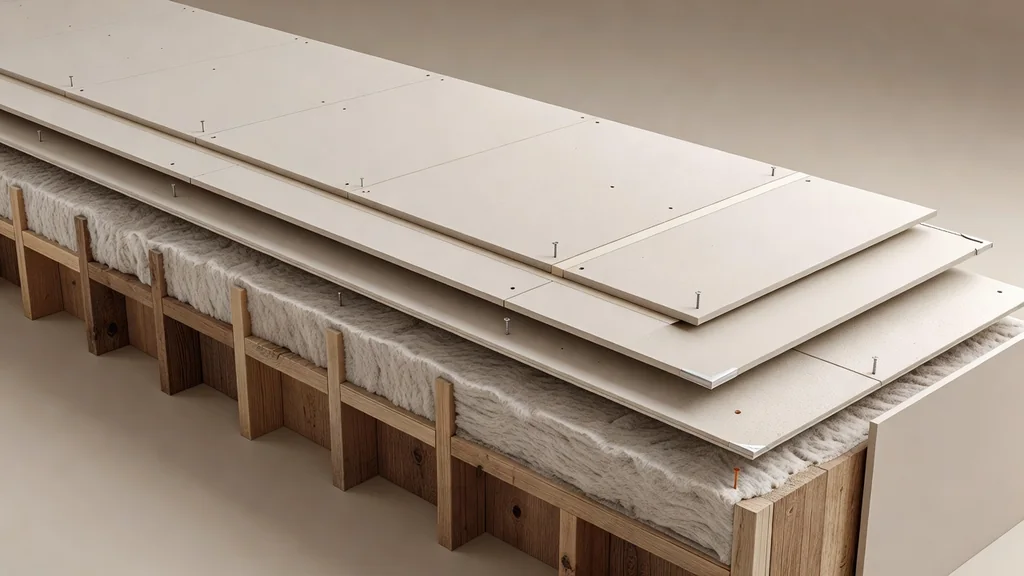
Common Uses in Homes and Commercial Buildings
Standard wall and ceiling surfaces are the most visible uses, but drywall also forms soffits, chases, returns, bulkheads, mechanical enclosures, tenant partitions, shafts, and components of tested assemblies.
Residential projects can include:
- small wall and ceiling repairs;
- basement finishing and remodels;
- room additions and layout changes;
- repairs after plumbing or electrical access;
- ceiling texture changes;
- garage and utility-area assemblies; and
- replacement after corrected water damage.
Commercial projects can include restaurants, offices, retail, managed properties, tenant improvements, occupied-space repairs, new partitions, finish corrections, and punch-list work. The team handles all commercial project and building types, with the actual plans, access, assembly, operations, and finish standard defining the scope.
The commercial drywall page explains intake, containment, phasing, and trade coordination for active facilities.
Drywall, Sheetrock, and Plaster Are Not the Same Terms
Drywall and gypsum board are common generic terms for factory-made gypsum panels. Sheetrock is a USG brand name that people often use casually for drywall, much like a brand name becoming shorthand for a product category. A project specification should still identify the actual manufacturer, product, thickness, facing, edge, and assembly requirements instead of relying on the nickname.
Traditional plaster is installed as a wet material over lath or another suitable base. It can create a hard, character-rich surface and is common in older homes. Drywall uses large factory-made panels with finished joints, so new walls are generally faster and more repeatable to build. Plaster repair can require different materials, preparation, and craft than a gypsum-panel patch. Covering damaged plaster with drywall is not automatically the right repair because trim depth, wall thickness, movement, and hidden deterioration still matter.
Practical Advantages and Limitations
Drywall became common because it offers several practical advantages:
- large panels enclose rooms faster than multi-coat traditional plaster;
- standardized products make thickness and assembly planning repeatable;
- joints, holes, and many localized defects can be repaired;
- specialty panels support moisture, impact, fire, acoustic, and exterior applications when used in the correct complete system; and
- smooth, textured, primed, and painted finishes can be built over one familiar substrate.
It also has limits:
- gypsum panels lose strength when they remain wet;
- face paper and corners can be damaged by impact;
- joints and fasteners can show when framing, installation, drying, or lighting conditions are poor;
- heavy fixtures need suitable framing, backing, or approved anchors; and
- a panel label by itself does not create a fire rating, sound rating, waterproof surface, or mold-proof room.
Those tradeoffs are why product selection and workmanship matter more than asking whether drywall is universally “better” or “worse” than another wall system.
Why Thickness and Assembly Listings Matter
Common panel thicknesses include 1/4, 3/8, 1/2, and 5/8 inch, but availability and approved uses vary. A repair should usually match the existing plane. A ceiling must account for framing spacing, orientation, texture, and sag resistance. A fire- or sound-rated wall must follow its complete tested design.
The drywall thickness guide compares common options. The most important rule is that thickness alone does not create fire resistance or sound isolation. The assembly does.
Openings and penetrations deserve the same care. A plumber or electrician may create a neat access cut, but the drywall repair still needs backing, board fit, joint planning, texture, and finish. Rated conditions can require specific restoration details rather than an ordinary patch.
Repair, Replacement, and Finish Decisions
A patch can work when the surrounding panel is dry, sound, supported, and able to hold a stable transition. Replacement becomes more likely when board is soft, swollen, sagging, crushed, delaminated, repeatedly patched, visibly contaminated, or unsupported beyond the repair boundary.
The seamless patching guide explains how backing, board fit, compound width, texture, primer, and paint affect the finished result.
Finish expectations should be stated before work begins. “Patch the hole” could mean board and tape only, a smooth paint-ready wall, matched orange peel or knockdown, a primed surface, or complete paint matching. Those are different scopes.
The team can include texture matching, paint matching, and proper final finishing when the project calls for them. When sanding requires it, the team plans tarps and appropriate dust-containment measures. Utah Drywall & Repair guarantees its workmanship on the drywall and finish scope stated in the estimate.
Frequently Asked Questions
What is drywall made from?
Most common drywall uses a gypsum core faced with paper, although specialty products can use treated papers, fiberglass mats, additives, or different core formulations.
Why did drywall replace so much traditional plaster?
Gypsum panels made interior wall construction faster and more repeatable because large factory-made sheets could be fastened to framing and finished at their joints.
Is every sheet of drywall interchangeable?
No. Thickness, core, facing, edge, dimensions, exposure limits, and listed assembly requirements vary. The selected panel must fit the location and complete system.
What makes a drywall wall look continuous?
Supported panels, controlled fasteners, taped joints, corner treatment, compound coats, sanding, texture, primer, and paint work together to create one visual plane.
Can old drywall be patched instead of replaced?
Often, if the surrounding board is sound, dry, supported, and compatible with a stable patch. Soft, wet, sagging, contaminated, or extensively damaged board may require replacement.