Have you ever walked into a room, looked at the walls, and just felt like something was off? Maybe the texture is too heavy, catching shadows in weird ways, or maybe there are just too many dings and patches from years of living. Honestly, nothing makes a house feel dated quite like rough, uneven wall textures—I’m looking at you, heavy orange peel and knockdown.
Contents
So, What Exactly is Skim Coating?
Before we start filling up your shopping cart, let’s get on the same page about what we are actually doing here. Skim coating is essentially the art of applying a thin layer of joint compound over an entire wall or Ceiling to smooth out the surface. Think of it like icing a cake, but the cake is your drywall and the icing is mud.
You might be doing this to cover up an old, ugly texture, or maybe you pulled off some wallpaper and the drywall underneath looks like a topographical map of the Rocky Mountains. Whatever the reason, the goal is a Level 5 finish—that’s industry speak for walls so smooth they look like glass.
Here’s the thing, though. While the concept is simple, the execution takes a bit of finesse. And more importantly, it takes the right gear. You can’t just grab a putty knife and hope for the best.
The “Mud”: Choosing the Right Compound
You can’t skim coat without the coat, right? In the drywall trade, we call joint compound “mud.” It’s the lifeblood of the project. But walking down the aisle at the hardware store can be overwhelming because there are buckets with blue lids, green lids, and boxes with powder.
For a skim coat project, you generally have two main choices:
- All-Purpose Joint Compound (The Green Lid): This stuff contains more glue (adhesive polymers). It bonds really well, which is great if you are going over painted surfaces. However, it shrinks a bit more when it dries and it is harder to sand.
- Lightweight All-Purpose (The Blue Lid): This is usually the go-to for the final skim coats. It’s easier to sand and weighs less, which your shoulders will thank you for after three hours of work.
Pro Tip for Utah Residents: Since we live in a high-desert climate—whether you’re in Salt Lake or down in Provo—the air is dry. Mud dries fast here. I usually recommend thinning your mud with a little water until it’s the consistency of yogurt or soft-serve ice cream. It spreads easier and gives you a little more working time before it sets up.
Avoid the “hot mud” (the powder in bags that sets in 20 or 90 minutes) for skimming unless you are doing deep patches first. That stuff sets rock hard and is a nightmare to sand smooth over a large area.
The Essential Hand Tools
Okay, let’s talk hardware. You don’t need a van full of equipment, but you do need a few specific items to keep you from losing your mind.
The Knife and The Pan
You might have a little 4-inch spackle knife in your junk drawer. Leave it there. For skim coating, bigger is almost always better.
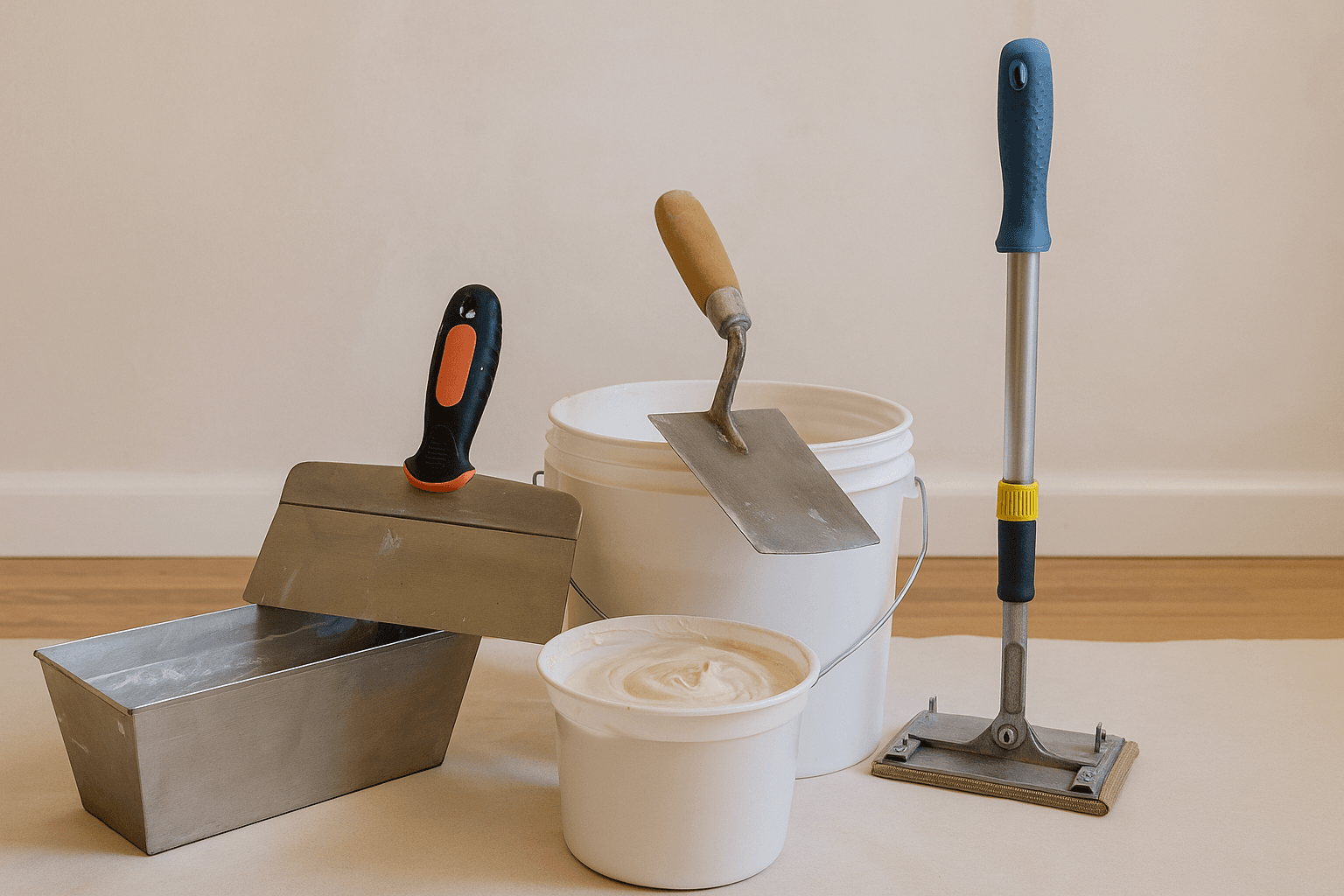
- 10-inch or 12-inch Taping Knife: This is your main weapon. A wider blade helps you bridge low spots and valleys in the wall. If you use a small knife, you’ll just follow the bumps that are already there, which defeats the purpose.
- The Mud Pan: This is the trough you hold in your left hand (if you’re right-handed) to hold the mud. Stainless steel pans are worth the extra couple of bucks because they don’t rust and are easier to clean than the plastic ones.
Some old-school pros prefer a hawk—that flat square plate with a handle underneath. It holds more mud, but honestly? It takes some serious practice to keep the mud from sliding off onto your boots. For most homeowners, a pan is more forgiving.
The Skimming Blade (The Game Changer)
If you want to feel like a wizard, look into a skimming blade. These are long, wide blades (sometimes 24 to 32 inches wide) that you hold with two hands. You pull them down the wall, and they smooth out massive sections in seconds. It’s a bit of an investment, but if you are doing a whole room, it pays for itself in time saved.
The Application Tools: Rollers and Squeegees?
Wait, paint rollers? Yes. Let me explain.
Traditionally, you’d scoop mud out of a bucket, put it on the wall with a knife, and spread it. That works, but it’s slow and physically exhausting. The modern way—and the way we often do it to ensure consistency—is the roll-on, squeegee-off method.
Here is what you need for this technique:
- Thick Nap Paint Roller (1/2 inch to 3/4 inch): You dip this into your thinned-down mud and roll it onto the wall just like paint. It gets the mud on the wall fast and even.
- The Squeegee Knife: Once the mud is rolled on, you use your wide taping knife or skimming blade to wipe it smooth, removing the excess.
It sounds weird, but it works incredibly well. It ensures you have a uniform thickness across the wall, preventing humps and waves.
Don’t Forget the Prep Materials
You know what? The biggest mistake I see DIYers make isn’t the skimming itself; it’s the lack of prep. If you try to put fresh wet mud over a dirty, glossy, or dusty wall, it might just bubble up and fall off. Not a good look.
Here is a quick checklist of prep materials you can’t ignore:
| Item | Why You Need It |
|---|---|
| TSP (Trisodium Phosphate) | Degreases the walls. Kitchens and hallways are usually covered in invisible finger oils. |
| Sanding Sponge | Scuff up the old paint. Mud needs a “tooth” to grab onto. |
| PVA Primer or Bonding Agent | If the surface is really slick or painted with high-gloss paint, a bonding primer ensures the new mud sticks for good. |
| Fiberglass Mesh Tape | For any cracks you find before you start skimming. Mud alone won’t stop a crack from coming back. |
The Messy Reality: Sanding Gear
I won’t lie to you—sanding is the worst part. It’s messy, it’s boring, and it gets everywhere. But it is the difference between a “good enough” job and a “wow” job.
When the mud is dry, you need to sand it smooth.
- Pole Sander: This is a sanding head attached to a broom handle. It lets you sand the upper walls and ceilings without climbing up and down a ladder every two minutes.
- 120-Grit and 220-Grit Paper: Start with 120 to knock down the ridges, then switch to 220 for that baby-smooth finish.
- Sanding Sponges: These are crucial for corners and detailed areas where a pole sander is too clumsy.
Safety First: Do not skip the mask. Drywall dust is incredibly fine and bad for your lungs. Get a good N95 respirator, not just those cheap surgical masks. Also, cover your furniture and vents. That dust travels through HVAC systems like a ghost.
Is It Worth Doing Yourself?
Skim coating is one of those tasks that looks easy on YouTube. You watch a guy in fast-forward smooth out a wall in thirty seconds, and you think, “I can do that.” And you probably can! But it is physically demanding. It requires a lot of upper body strength, patience, and a tolerance for dust.
If you are just doing one small accent wall, go for it. Grab a pan, a 12-inch knife, and some lightweight mud. But if you are looking at a whole living room, a vaulted ceiling, or a hallway with tricky corners, the learning curve can be steep.
It’s about rhythm. Professional drywall finishers have a muscle memory that helps them apply the right amount of pressure at the right angle. When you don’t have that, you end up sanding… and sanding… and sanding some more to fix the ridges you left behind.
Plus, in our Utah climate, you have to work somewhat quickly. If that thin layer of mud dries before you smooth it out, it drags and tears, leaving you with a surface that looks worse than when you started.
Let Us Handle the Dust
If reading about sanding poles and mixing mud has you second-guessing your weekend plans, that’s totally fair. Skim coating is an art form, and sometimes it’s best to bring in the artists.
At Utah Drywall & Repair, we specialize in transforming bumpy, dated walls into smooth, modern canvases. We have the industrial tools, the right materials, and the experience to get that Level 5 finish without you having to lift a finger (or breathe in a cloud of dust).
We serve homeowners all across Salt Lake County, Davis County, and Utah County. Whether you’re renovating a historic home in the Avenues or updating a split-level in Bountiful, we’ve got you covered.
Ready for smooth walls? Let’s chat.