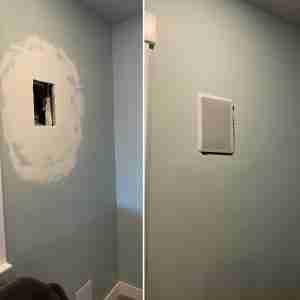
Nothing ruins the vibe of a freshly painted room quite like a glaring dent or a hole from that time the doorknob slammed into the wall a little too hard. It’s one of those things you can’t unsee, and honestly, trying to fix it yourself often makes it stand out even more if you aren’t careful. But getting that perfect, invisible finish isn’t magic; it just takes the right technique and a little bit of patience.
Contents
So, Why Does My Patch Look Like a Lump?
You’ve probably been there. You grab a tub of spackle, smear it over the hole, wait for it to dry, and sand it down. But once the paint goes on, there it is—a hump on the wall that catches the light every single afternoon. It’s frustrating.
Here’s the thing: Drywall Repair is less about filling a hole and more about optical illusions.
When professional drywallers—like our crew here along the Wasatch Front—fix a patch, we aren’t just plugging the gap. We are blending the surface so your eye glides right over it. If you build the patch up too high, you get a bump. If you don’t build it out wide enough, you see the edges. The goal is to make the wall feel flat, even if there is a tiny, imperceptible layer of compound sitting on top of it.
Most homeowners make the mistake of using just the small putty knife that comes in those cheap repair kits. That’s okay for a nail hole, but anything bigger requires tools that allow you to “feather” the edges.
The Gear You Actually Need (And What to Skip)
Before we get into the messy part, let’s talk tools. You don’t need to buy out the hardware store, but having the right knife makes a massive difference. Using a 2-inch blade to fix a doorknob hole is like trying to mow a lawn with scissors. It’s just going to end poorly.
| Tool | Why You Need It | Pro Tip |
|---|---|---|
| 6-Inch Taping Knife | Great for the initial fill and getting mud into the hole. | Look for a flexible metal blade, not plastic. |
| 10 or 12-Inch Knife | Essential for feathering the edges so the patch disappears. | Keep the blade clean; dried bits cause scratches. |
| Setting-Type Compound | Also called “hot mud,” it sets chemically and doesn’t shrink much. | It comes in powder form. Use the “20-minute” version. |
| Sanding Sponge | Follows contours better than rigid sandpaper. | Get a medium/fine grit. |
| Fibreglass Mesh Tape | Easier for DIYers than paper tape; stickier and stronger. | Don’t overlap it; just cover the seam. |
The “California Patch”: A Utah Favorite
For holes roughly the size of a doorknob (we see these a lot in Davis County homes with active kids), you don’t always need to cut the drywall back to the studs. There is a technique called the California Patch, or a “hot patch,” that works wonders.
It sounds fancy, but it’s actually pretty straightforward.
- Cut a square piece of new drywall about two inches larger than the hole on all sides.
- Score the back of that new piece about an inch from the edge, all the way around.
- Snap the gypsum core but—and this is crucial—do not cut the paper on the front face. Peel the gypsum off the back edges.
- You are left with a square plug of drywall surrounded by a border of paper.
- Apply mud around the hole in the wall, insert the plug, and use the paper border as your tape.
It lays flatter than traditional mesh tape, which means you have less “hump” to hide later. It’s strong, it’s fast, and it saves you from having to screw in wood backing behind the wall.
The Art of Feathering (Or, Making it Invisible)
This is where the artistry happens. Once your patch is in place and the first coat of mud is dry, you’re going to look at it and think, “Wow, that looks terrible.” Don’t panic. It’s supposed to look rough at this stage.
The secret to invisibility is feathering.
Imagine the patch is the top of a very low hill. If the hill has steep sides, everyone notices it. But if the hill slopes down gently over a long distance, it looks flat. You want to spread your joint compound out wide—much wider than you think.
For a 4-inch hole, your final layer of compound might be 10 or 12 inches wide.
Here is the technique:
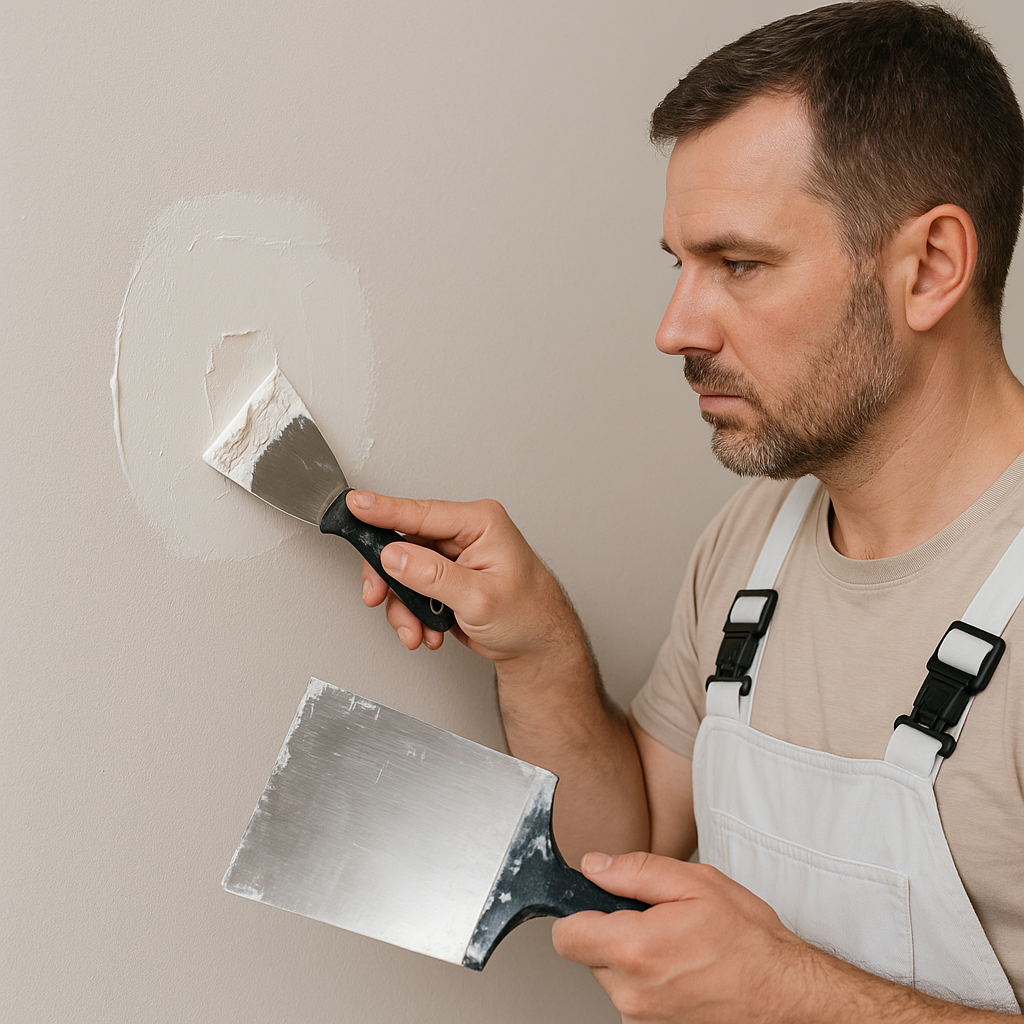
Load up your 12-inch knife. Place it on the wall, apply pressure to the outside edge of the blade (the side touching the painted wall), and float it over the patch. You are trying to create a seamless transition from the repair to the existing wall.
If you leave ridges, don’t try to fix them while the mud is wet. You’ll just make it worse. Let it dry, scrape it off, and try again. In our dry Utah climate, the mud dries pretty fast, so you have to move somewhat quickly, but don’t rush the actual stroke.
Texture: The Nemesis of Smooth Walls
If we lived in a world where every wall was perfectly smooth, my job would be a lot easier. But in Salt Lake and Utah Counties, textured walls are the norm. Orange peel, knockdown, skip trowel—we have it all.
If you patch a hole perfectly smooth and then paint over it, it will look like a bald spot on the wall. You have to match the texture.
For Orange Peel (the bumpy skin look):
You can buy cans of spray texture. But here is the catch: they almost never match perfectly right out of the can. Shake the can until your arm hurts. Then, test it on a piece of cardboard. Adjust the nozzle to match the size of the droplets on your wall.
For Knockdown (the flattened islands look):
This is trickier. You spray on heavier blobs of texture, wait about 10 to 15 minutes for it to set slightly, and then gently wipe a wide knife over it to flatten the tops.
It’s an art form, honestly. If you spray too much, it looks like a mess. Too little, and the patch shows through.
The Step Everyone Wants to Skip: Priming
You’ve patched, you’ve sanded, you’ve textured. You are ready to paint, right?
Not so fast.
Fresh joint compound absorbs paint differently than the surrounding painted wall. If you paint directly over the patch, it will suck the sheen right out of the paint. This is called “flashing.” Even if the color matches perfectly, you will see a dull, matte spot where the repair is.
You absolutely need to seal that patch with a PVA primer or a good-quality drywall primer. It seals the porous surface so the topcoat sits evenly. It adds an extra twenty minutes to the job, but it saves you from looking at a dull spot on your living room wall for the next five years.
When to Throw in the Towel
Look, we love a good DIY spirit. But there are times when a repair is more than just a “patch.”
If you are dealing with water damage (common in older basements), the drywall might be compromised well beyond the visible stain. Cracks that keep coming back usually indicate structural movement, and slapping mud over them is just a temporary band-aid. And let’s be real—Ceiling repairs are a nightmare. Fighting gravity while trying to feather a joint is a workout nobody asks for.
Sometimes, the effort and the cost of buying tools, mud, texture cans, and paint just isn’t worth the headache, especially if the result is still… well, visible.
If you’re staring at a hole in your wall and dreading the dust, or if you’ve tried to fix it and it just looks like a glob of dried toothpaste, it might be time to call in the cavalry. At Utah Drywall & Repair, we make walls look like nothing ever happened. We handle the dust, the Texture Matching, and the clean-up.
Ready to make that hole disappear?
Don’t let a damaged wall distract from your beautiful home. We serve homeowners across Salt Lake, Davis, and Utah Counties with fast, seamless repairs.