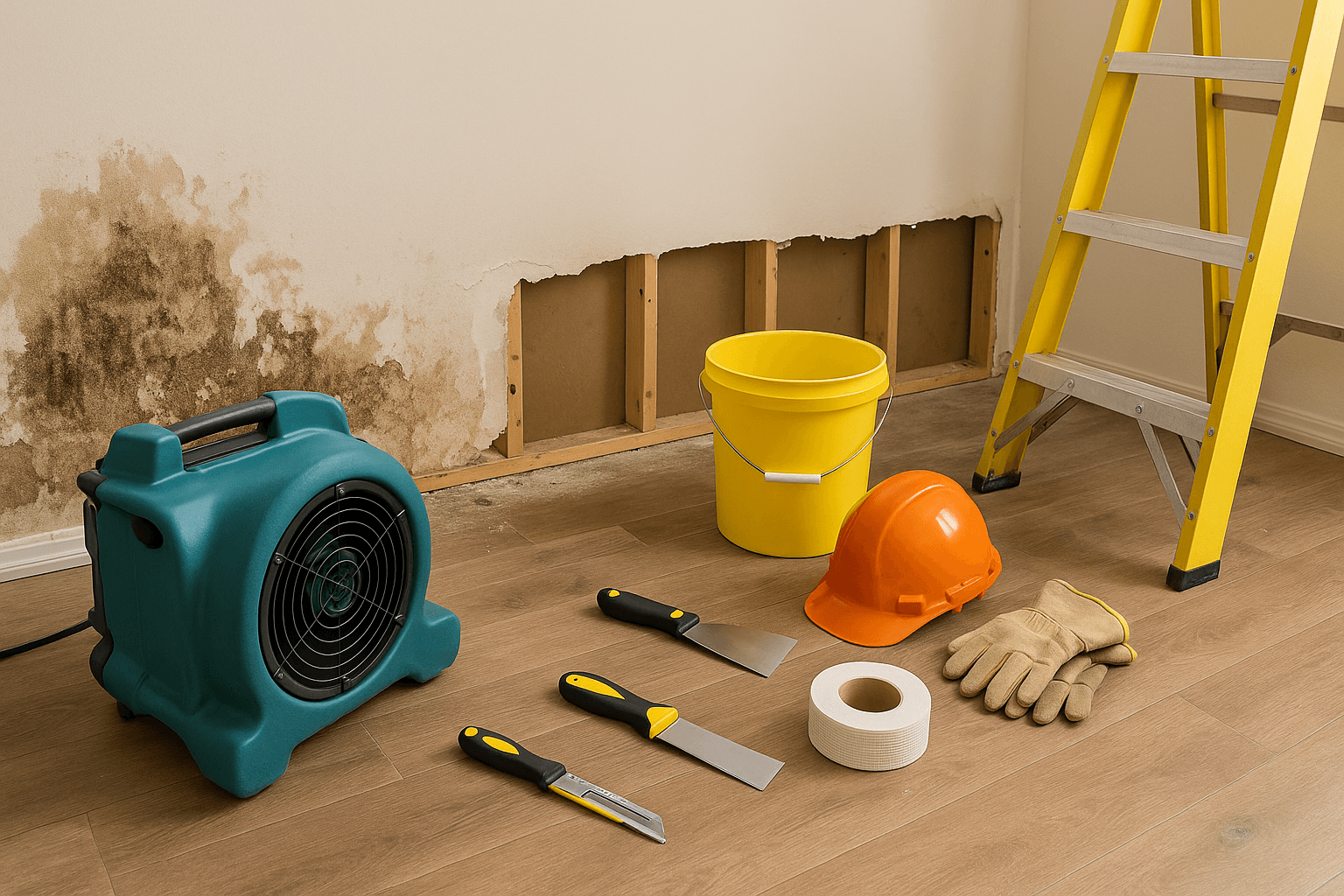
There is nothing quite like the sinking feeling of walking into your Basement and seeing a dark, spreading stain on the Ceiling or a squishy section of wall. Whether it’s from a burst pipe in Sandy or melting snow seeping into a foundation in Davis County, water damage is a headache that doesn’t go away on its own. If you’re thinking about tackling the fix yourself, you need more than just a bucket and a prayer—you need the right gear to keep mold at bay and get your walls looking normal again.
Contents
First Things First: Safety and Assessment Gear
Before you even think about cutting into a wall, you have to know what you’re dealing with. Water travels, and where you see the stain isn’t always where the water is coming from. Plus, wet drywall can hide some pretty nasty stuff like black mold or electrical hazards.
Honestly, don’t skip the personal protective equipment (PPE). I know, I know—it’s tempting to just jump in with a t-shirt and squinty eyes, but wet gypsum dust and potential mold spores are bad news for your lungs. You’ll want a decent N95 respirator mask and some safety goggles that actually seal around your eyes.
You also need a way to see what the naked eye can’t.
- Moisture Meter: This is non-negotiable. You can’t just touch the wall and say, “Yeah, feels dry.” A moisture meter tells you if the studs behind the drywall are still soaked. If you patch over wet wood, you’re just building a mold farm.
- Voltage Tester: Water and electricity are a terrible mix. Before you cut, use a non-contact voltage tester to make sure you aren’t slicing into a live wire.
- Bright Work Light: Basements and corners are dark. You need to see the texture and the extent of the damage clearly.
The Demolition Phase: Getting the Gross Stuff Out
Okay, so you’ve turned off the power and you’re masked up. Now comes the messy part. You have to remove everything that is compromised. Drywall acts like a sponge; once it swells, it doesn’t shrink back to its original shape. It just crumbles.
You might think a hammer is the tool for this, but swinging a hammer wildly usually results in more damage than you planned. You want controlled destruction.
The Essential Cutting Tools
For a clean removal, you need a utility knife with a fresh pack of blades. I cannot stress this enough—change the blade often. A dull blade tears the paper face of the drywall, which peels back and makes Patching a nightmare later on. You want a crisp, clean line.
You’ll also want a jab saw (sometimes called a drywall saw). It looks like a serrated knife and is perfect for punching through the board and sawing out squares. Just watch out for pipes!
Here is a quick checklist for the demo bag:
- Pry Bar: For gently removing baseboards without snapping them.
- Claw Hammer: Good for pulling nails left in the studs.
- Heavy-Duty Trash Bags: Wet drywall is heavy. Like, deceptively heavy. Get contractor bags, not the wimpy kitchen ones.
Choosing the Right Replacement Material
You know what? This is where a lot of homeowners in Utah County get tripped up. They go to the big box store and buy the cheapest sheet of white drywall they see.
If you are repairing water damage, regular drywall might not be the best pick, especially if it’s in a bathroom, laundry room, or a basement that tends to stay humid. You should look for moisture-resistant drywall. You’ll often hear pros call it “Green Board” or “Purple Board” because of the color of the paper facing.
These boards are treated to resist moisture absorption and mold growth. Is it a little more expensive? Sure. Is it worth it so you don’t have to do this again next year? Absolutely.
The Mud Matters
Then there is the joint compound, or “mud.” For water damage repairs, I usually recommend starting with a setting-type compound, often called “hot mud.” It comes in a powder and you mix it with water.
Why use the powder? Because it sets chemically rather than by drying out. This means it hardens faster and is much stronger against shrinkage than the pre-mixed stuff in the bucket. However, it’s harder to sand, so use it for the first coat to fill the gaps, then maybe switch to a lightweight pre-mixed mud for the finish coat.
Tools for the Reconstruction
Once the new piece of board is screwed in (use coarse-thread drywall Screws for wood studs, by the way), you have to make the seams disappear. This is the art form of the trade. If you rush this, you’ll see the patch forever.
You need a progression of knives. You can’t do the whole job with one tool.
| Tool | Purpose | Why you need it |
|---|---|---|
| 6-Inch Taping Knife | Bedding the Tape | Getting the mud tight into the seam without making a mess. |
| 10 or 12-Inch Knife | Feathering the edges | Spreading the mud wide so the hump disappears visually. |
| Mud Pan | Holding the compound | Stainless steel is best so it doesn’t rust or crack. |
Paper vs. Mesh Tape
This is an age-old debate. For patches, fiberglass mesh tape is often easier for DIYers because it’s self-adhesive. You stick it on, and then mud over it. However, if you use mesh, you must use the setting-type compound (hot mud) we talked about earlier. Mesh tape is flexible; if you use regular drying mud, the crack will likely come back.
If you are using pre-mixed bucket mud, stick to paper tape. It’s stronger, but trickier to apply without getting bubbles.
The Sanding and Texture Struggle
Let’s be real for a second—sanding is the absolute worst part of drywall work. It’s dusty, it’s tiring, and if you do it wrong, you ruin the smooth surface you just created.
In the dry air here in Salt Lake, mud dries pretty quick, which is nice. But that fine white dust gets everywhere. You’ll want a pole sander to save your back and arms. It allows you to sand from a distance and apply even pressure.
For the details, get a sanding sponge. They are great for corners and for “feathering” the edges of your patch so it blends perfectly into the existing wall.
Matching the Texture
This is the step that separates the pros from the “I did it myself” look. Most homes in Utah have some texture—orange peel, knockdown, or skip trowel. You can buy spray texture cans for small patches. They are hit-or-miss, honestly. You have to adjust the nozzle and do a test spray on a piece of cardboard first. If the pressure is wrong, it just looks like a blob.
Priming and Painting: Hiding the Evidence
You might think you’re done once the texture is dry, but water damage has a nasty habit of bleeding through paint. That brown water stain? It will laugh at regular latex paint and soak right through it.
You need a stain-blocking primer. Oil-based primers (like Kilz Original or Zinsser Cover Stain) are the gold standard for water stains. They smell a bit strong, so open a window, but they seal that stain permanently. There are some good water-based hybrids now, but if the stain is dark, stick to oil.
Once the primer is dry, you can apply your topcoat. Just make sure you paint the whole wall, corner to corner. If you just paint the patch, the sheen difference will catch the light, and everyone will know exactly where the leak was.
When to Call in the Cavalry
Look, having the right tools is half the battle. But the other half is technique, patience, and time. Water damage restoration involves a lot of waiting—waiting for walls to dry, waiting for mud to set, waiting for primer to cure. And if you don’t have these tools sitting in your garage already, the cost of buying a moisture meter, drills, saws, knives, and sanders adds up fast.
Sometimes, the smartest tool you can use is your phone.
If you are looking at a soggy ceiling or a warped wall and thinking, “I do not have the time or the patience for this,” that is totally fair. Getting a seamless finish that matches your existing texture is tough, even for handy homeowners.
We handle everything from the demo to the final texture match, ensuring your home looks like the water damage never even happened. We serve homeowners all over Salt Lake County, Davis County, and Utah County.