We’ve all been there—you’re moving a couch around a tight corner, or maybe a doorknob slammed into the wall a little too hard, and suddenly you’re staring at an ugly hole in your living room. It’s frustrating, sure, but the real headache usually starts when you try to fix it and realize that making a wall look smooth again is actually an art form.
Contents
1. Skipping the “Cleanup” Phase
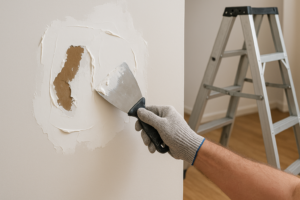
Honestly, this is where most DIY patch jobs go wrong before a single drop of mud touches the wall. It’s human nature to want to fill the void immediately. You see a hole, you want to plug it. But if you just slap some spackle over a jagged hole, you’re setting yourself up for an ugly bump that no amount of Sanding will fix.
When drywall breaks, the brown paper backing tends to tear and fuzz up. We call these “burrs.” If you try to mud over them, the moisture in the compound makes that paper swell, creating a permanent raised spot.
Here’s the fix: You have to be a little destructive to be constructive. Take a utility knife and cut a clean rim around the hole. You want to bevel the edges inward slightly. If there are any loose bits of paper, peel them off or sand them down until the edges are solid. You know what? It feels wrong making the hole slightly bigger or cutting into your wall, but that clean edge is the only way to get the patch to sit flush with the existing surface. Think of it like prepping a wound before a bandage—if it’s not clean, it won’t heal right.
2. Using the Wrong “Mud” for the Job
Walk into any hardware store in Salt Lake or down in Provo, and you’ll see an entire aisle dedicated to white pastes. It’s overwhelming. A lot of homeowners grab the small tub of lightweight pink spackle—the kind that turns white when it dries—because it promises to be easy.
Here’s the thing: Lightweight spackle is great for tiny nail holes from picture frames. It is terrible for anything larger than a dime. It doesn’t dry hard enough to sand smoothly, and it often flashes (shows up as a dull spot) through the paint later.
For a hole specifically, you need actual joint compound. But even then, you have choices.
| Material | Best Used For | Pros | Cons |
|---|---|---|---|
| Spackle | Tiny nail holes | Dries fast, no shrinking | Soft, hard to sand perfectly smooth |
| All-Purpose Compound | Top coats & finishing | Easy to sand, long working time | Shrinks heavily, takes 24hrs to dry |
| Setting-Type (Hot Mud) | Filling big gaps | Dries rock hard in minutes, minimal shrinking | Very hard to sand, sets too fast for beginners |
If you are Patching a doorknob hole, use all-purpose joint compound or a setting-type compound for the first fill. In our dry Utah climate, the premixed bucket stuff is usually the safest bet for homeowners because it gives you plenty of time to work with it before it sets up. Just be prepared for it to shrink a little as it dries; that’s natural.
3. Ignoring the Tape (and Structural Integrity)
You might think, “The hole is only two inches wide; I can just fill it.” Well, you can, but gravity and vibration are working against you. Without backing or tape, the compound will eventually crack around the edges of the hole. It might look fine for a week, but the first time someone slams the front door, a hairline crack will appear.
For anything larger than a nickel, you need some kind of reinforcement.
- For small holes: A self-adhesive fiberglass mesh patch is usually the easiest route for DIYers. It sticks to the wall, and you just mud right over it.
- For medium holes: You might need to use a “California patch” (using a piece of drywall with the paper left on) or cut a new square of drywall and screw it to a backing strip of wood behind the wall.
If you skip the tape or the backing, you aren’t really repairing the wall; you’re just plugging it with chalk. The patch needs to become part of the wall, not just a filler sitting inside it.
4. The “Mound” Mistake (Overfilling)
This is the most common visual defect we see when we get called out to fix a DIY attempt in Davis County. The homeowner applied the mud, but now there is a noticeable hump on the wall.
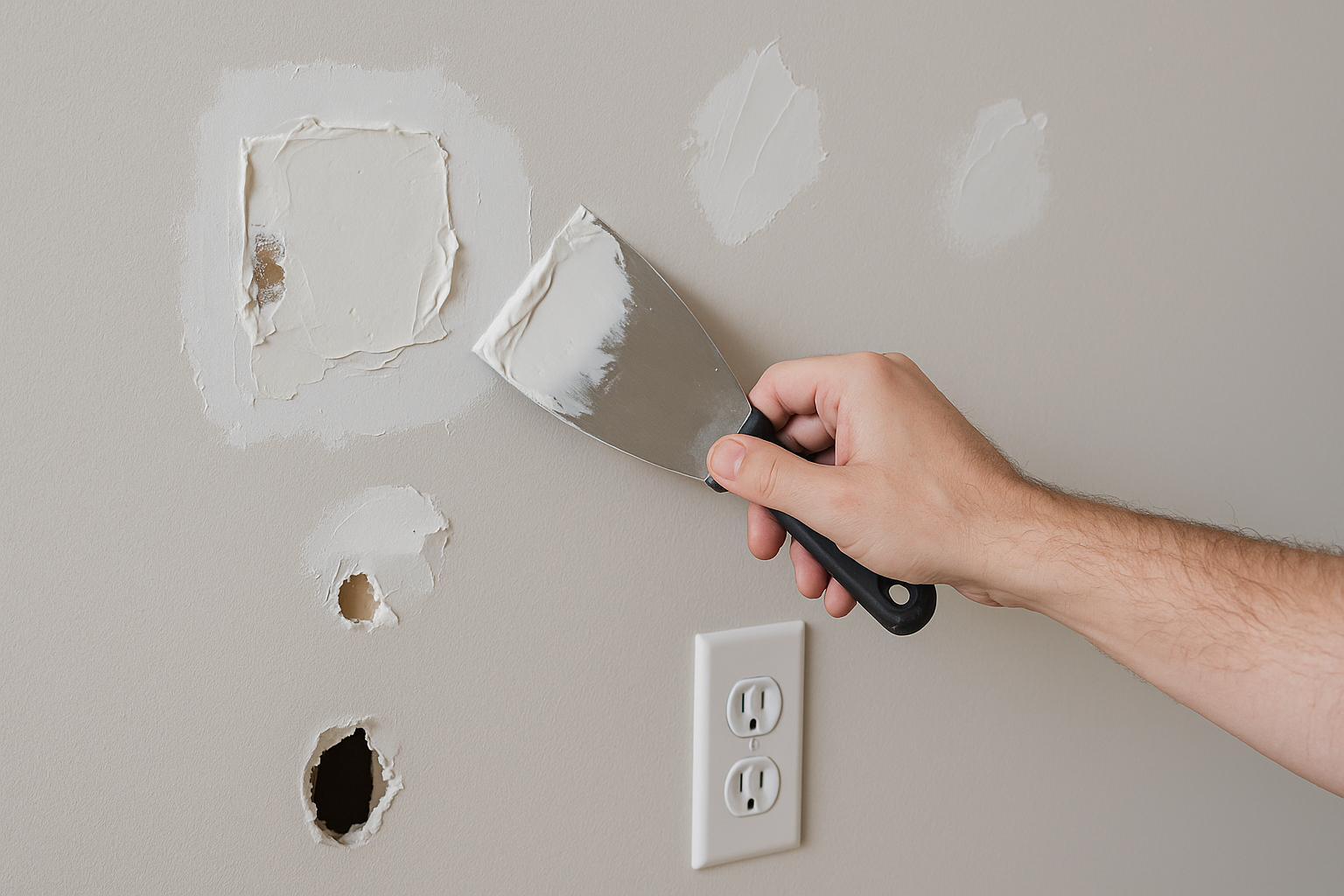
It happens because people try to finish the job in one coat. They pile the mud on thick to cover the tape, sand it a little, and paint. But because the tape or patch sits on top of the surface, you have to trick the eye into thinking the wall is flat. This is called feathering.
You can’t just cover the hole; you have to spread the compound out wide—sometimes 10 or 12 inches away from the center of the repair. By gradually decreasing the thickness of the mud as you move away from the center, you blend the hump into the surrounding wall.
Pro Tip: Use a wide drywall knife (10-inch or 12-inch) for your final coat. Apply pressure on the outer edge of the knife to scrape the mud down to almost nothing at the borders. If you can feel the edge of the patch with your eyes closed, you will definitely see it when the lights are on.
5. Forgetting the Texture (The Utah Problem)
Let’s be real about where we live. Smooth walls are rare in Utah. Most homes in Sandy, Draper, and Layton have some form of texture—usually Orange Peel, Knockdown, or an older Skip Trowel finish.
If you patch a hole, sand it perfectly smooth, and then paint it, it’s going to look like a bald spot on your wall. It sticks out like a sore thumb. This is where a lot of people get discouraged because matching texture is genuinely difficult.
- Canned Texture: You can buy spray cans of orange peel texture. They can work, but they are messy and often spray out globs that look nothing like the rest of your wall. If you use these, test it on a piece of cardboard first to dial in the nozzle.
- The Sponge Method: For lighter textures, sometimes dabbing the wet mud with a damp sea sponge can mimic the surrounding look.
The mistake here is thinking the job is done after sanding. You have to recreate the landscape of the wall. If the texture doesn’t match, the patch will always catch the shadows differently than the rest of the room.
Is It Time to Call in the Pros?
Look, patching drywall is one of those things that looks deceptively simple. It’s just mud and tape, right? But getting it to look like nothing ever happened—especially with the tricky textures we have in our local homes—takes a steady hand and a lot of patience.
If you’ve got a patch that’s gone wrong, or if you just want to skip the dust, the mess, and the frustration of trying to feather out a repair three times, we’re here to help. At Utah Drywall & Repair, we make holes disappear so you can get back to enjoying your home.