Staring at a hole in your wall can feel like the wall is staring back, judging you for that doorknob accident or the plumbing repair you’ve been putting off. But here is a little secret that Contractors usually keep to themselves: fixing drywall isn’t actually rocket science, it’s mostly about having the right gear in your hand. You don’t need a van full of expensive equipment to get professional results, but you certainly need more than a butter knife and a can of old spackle.
Contents
Starting Small: The “Oops” Kit
If you are just trying to cover up a few nail holes from moving pictures around, or maybe a small dent where the kids got a little rowdy, you don’t need to go crazy. However, there is a massive difference between tools that work and tools that just frustrate you.
For these small jobs, the temptation is to buy those cheap, plastic throw-away spreaders. Don’t do it. Stainless steel putty knives are worth the extra few dollars. Plastic edges get jagged immediately, and then you’re just scratching lines into your wall that you’ll have to sand out later.
You’ll want a 4-inch or 6-inch Taping knife. Notice I didn’t say “putty knife.” A stiff putty knife is for scraping paint; a taping knife has a flexible blade that lets you feather the edges of the mud so it blends into the wall seamlessly. It’s all about the flex. If the blade doesn’t bend, your wall won’t look flat.
The Weekend Warrior: Renovating a Room
Okay, so you aren’t just filling a nail hole. Maybe you are finishing a Basement in Davis County or Remodeling a bedroom in Salt Lake. Now we need to talk about the “Holy Trinity” of drywall knives.
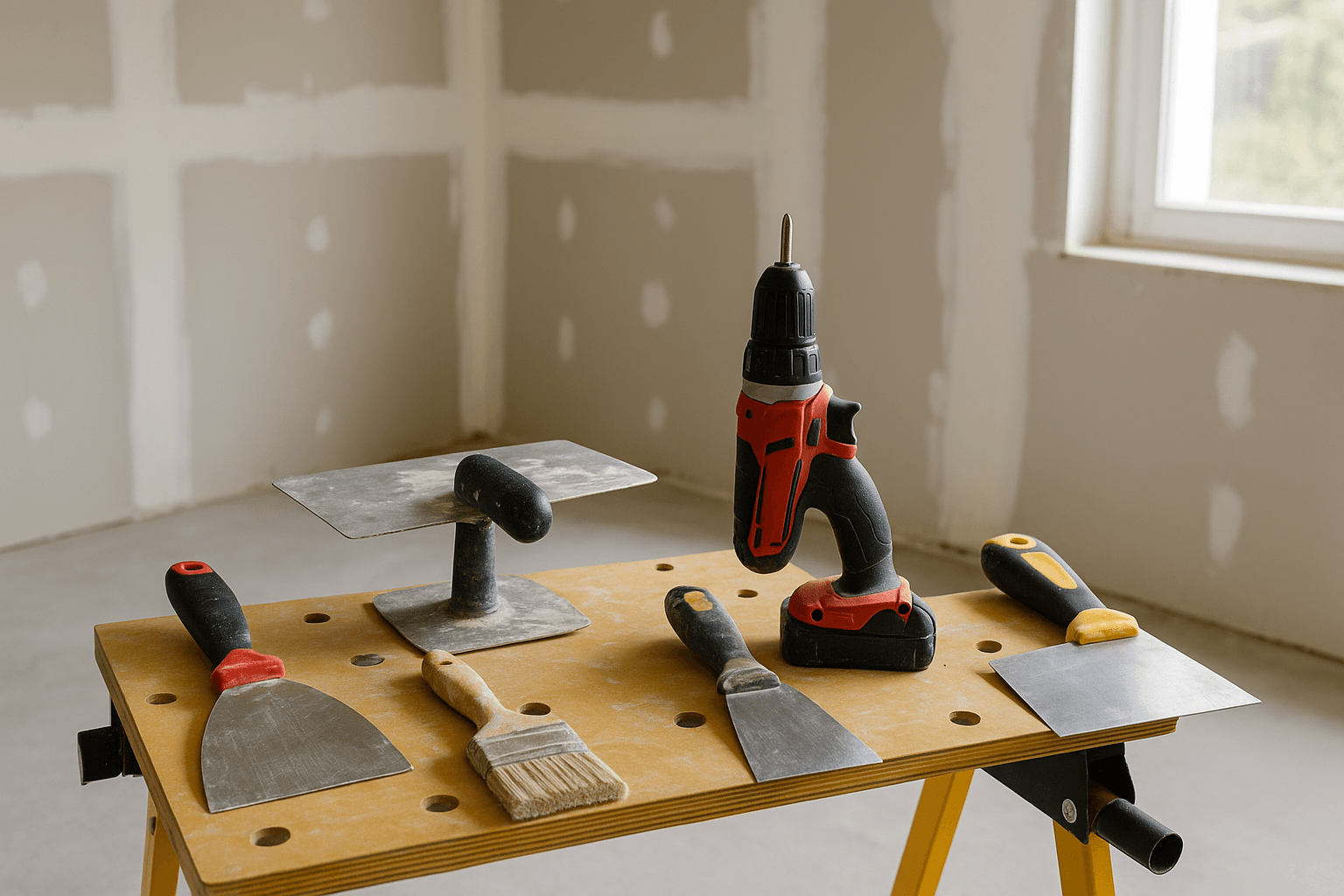
You cannot finish a joint with just one knife. It’s physically impossible to get it smooth. You need to layer the compound, making the patch wider each time to hide the hump. Here is the setup you should have:
- 6-inch Knife: For the first coat and embedding the paper or mesh Tape.
- 10-inch Knife: For the second coat, feathering the edges out further.
- 12-inch Knife: For the final skim coat, making that joint disappear entirely.
Honestly, if you skip the 12-inch knife, you are going to see lines. It helps you span the gap and float the mud properly. And look, stick to stainless steel. Carbon steel knives are great and traditional, but they rust if you look at them wrong. Unless you plan on oiling your tools after every single use (and let’s be honest, you won’t), stainless is the way to go.
The Great Debate: Mud Pan or Hawk?
If you have ever watched a pro crew working on a new build down in Utah County, you probably saw them carrying a flat square plate with a handle underneath. That’s a hawk. It holds a mountain of mud.
But here is the thing—using a hawk takes a lot of wrist technique. If you don’t have the muscle memory, you are going to drop a giant pile of wet joint compound right on your shoes. I’ve seen it happen a dozen times.
For the novice to intermediate DIYer, I almost always recommend a mud pan. It’s a rectangular trough with metal edges. It’s intuitive. You scoop the mud out, you wipe your knife clean on the edge, and you keep moving.
| Feature | Drywall Hawk | Mud Pan |
|---|---|---|
| Learning Curve | Steep (requires balance) | Easy (hold and scoop) |
| Capacity | Holds more mud | Holds less, refill often |
| Cleanliness | Prone to spills for beginners | Catches drips easily |
| Best For | Large ceilings & walls | Repairs & small rooms |
Mixing It Up: Drills and Paddles
Are you planning to use the pre-mixed bucket of mud (All-Purpose) or the powdered “hot mud” that sets in 20, 45, or 90 minutes?
If you are using the powder—which is great for deep patches because it doesn’t shrink as much—do not try to mix it by hand unless you want a workout that leaves your arm useless for the next two days. You need a mixing paddle that attaches to a heavy-duty drill.
A word of caution: Your standard battery-powered drill might struggle if the mud is thick. You can burn out the motor. If you have a corded drill, use it. The consistency you are looking for is like peanut butter (creamy, not chunky). If it’s too thick, it drags and tears the paper. If it’s too thin, it runs down the wall.
The Nemesis: Dust Control
This is the part everyone hates. Sanding. In our dry Utah climate, that fine white dust seems to hang in the air forever and settles on everything—your couch, your dog, your toothbrush.
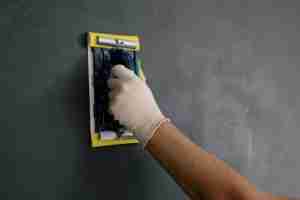
If you are sanding a large area, invest in a pole sander. It Screws onto a painter’s pole and lets you sand walls and ceilings without climbing up and down a ladder. It also keeps your face further away from the dust cloud.
But for smaller patches, or if you just hate the mess, try wet sanding. You use a special coarse sponge that is damp (not soaking wet). You rub the high spots in a circular motion. It dissolves the mud slightly to smooth it out. No dust. None. It takes a little practice to not rub too much off, but for a patch in a living room where you don’t want to cover all the furniture in plastic, it is a lifesaver.
When to Rent vs. When to Buy
You don’t need to own everything. Some tools are just too specialized.
If you are tackling high ceilings or a massive room, you might be tempted to look at drywall lifts or automatic tapers (often called Bazookas). Unless you are planning to start your own business, rent the lift. It saves your back. As for the automatic taper? Skip it. They are temperamental, hard to clean, and require a level of skill that takes years to master. Stick to hand taping; you have more control.
Also, avoid drywall stilts. I know, they look fun. But walking on stilts while handling sharp tools and looking at the Ceiling is a recipe for a trip to the ER. A good bench or a sturdy scaffold is much safer for a homeowner.
A Note on Utah Walls and Textures
One thing to keep in mind about working in the Salt Lake Valley is our texture. Most homes here aren’t perfectly smooth; they have “orange peel” or “knockdown” texture.
To match this, you might need a can of spray texture for small patches. The trick is to adjust the nozzle and test it on a piece of cardboard first. Never spray directly on the wall until you know what the pattern looks like. If you are doing a large area, you might need a hopper gun and a compressor, which sprays mud in a splatter pattern.
However, matching texture is an art form. It’s distinct from just taping flat seams. You can have the best tools in the world, but if the texture doesn’t match, the patch will stick out like a sore thumb when the light hits it.
Knowing When to Call for Backup
Acquiring the right tools is the first step, and it definitely bridges the gap between a messy amateur job and a decent repair. Having a good stainless steel knife, a stable mud pan, and the patience to sand properly will get you far.
But sometimes, you look at a project—maybe it’s a water-damaged ceiling, a massive remodel, or a texture match that just won’t look right—and realize that tools alone aren’t enough. Drywall finishing is one of those trades that looks easy until you try to get a seamless, glass-smooth finish. That comes from muscle memory, not just the hardware store.
If you are staring at a project that feels a little too big for your weekend, or if you just want to ensure your walls look perfect without the dust and hassle, we are here to help. We handle everything from small patches to full basement finishes across the Wasatch Front.
Utah Drywall & Repair
801-406-6350
Request a Free Quote