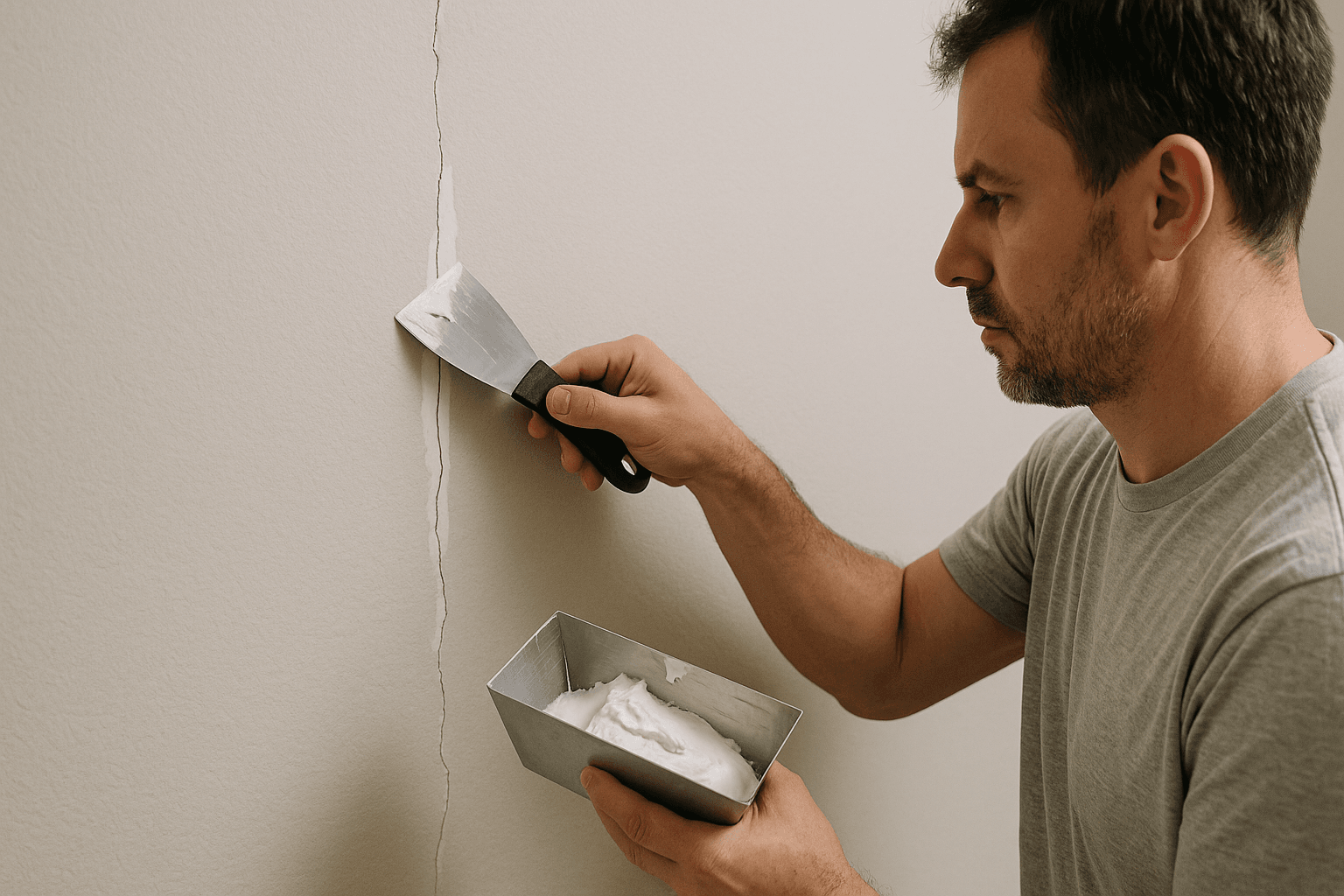
Walking into your living room and spotting a jagged line running up the wall is enough to ruin anyone’s Saturday morning mood. It’s that nagging imperfection that draws your eye every single time you sit down to relax, making you wonder if your house is slowly crumbling around you. Before you panic, take a deep breath—most drywall cracks are cosmetic, totally fixable, and honestly, a bit of a rite of passage for homeowners.
Contents
So, Why Do Walls Crack Anyway?
Here’s the thing about houses in Utah: they move. It sounds unsettling, but it’s true. Whether you are living in a historic bungalow in Sugar House or a new build out in Lehi, the soil beneath us is constantly shifting, especially with our freeze-thaw cycles. When the seasons shift from those blistering dry summers to snowy winters, the materials in your home expand and contract.
Sometimes, the wood framing dries out and shrinks slightly, pulling away from the drywall. Other times, it’s just the house “settling” into its foundation. You might notice these stress cracks popping up around door frames or windows. It’s frustrating, sure, but it’s rarely a sign of impending doom. It’s just physics doing its thing.
However, fixing it isn’t as simple as smearing some spackle over the line and Painting it. If you’ve tried that, you probably noticed the crack came back a month later, grinning at you from the wall. To banish it for good, we have to get a little surgical.
The “Surgery”: Cutting Before You Cure
It feels entirely counterintuitive, but to fix a crack, you actually have to make it bigger first. I know, it sounds crazy. Why would you take a utility knife to your wall?
If you just put mud (that’s the industry term for joint compound) over a hairline crack, it won’t penetrate deep enough to create a bond. It’s like putting a Band-Aid on a splinter without taking the splinter out. You need to create surface area for the compound to grab onto.
We use a technique called the V-groove. You take your utility knife and cut a ‘V’ shape along the length of the crack, carving out the loose drywall and old Tape. You want to get down to the stud or at least remove the debris causing the separation. It’s messy, and it creates dust, but it’s the only way to ensure the repair lasts longer than a Salt Lake winter inversion.
Paper vs. Mesh: The Great Tape Debate
Once you’ve carved out the crack and cleaned up the dust (seriously, use a vacuum; drywall dust gets everywhere), you need to reinforce the area. This is where a lot of DIY repairs go sideways. You can’t just fill the hole with mud; it will shrink and crack again. You need tape.
But which tape? If you walk down the aisle at the hardware store, you’ll see paper tape and fiberglass mesh tape.
Here is a quick breakdown of how they stack up:
| Feature | Paper Tape | Fiberglass Mesh Tape |
|---|---|---|
| Strength | Very high tensile strength (resists tearing). | Weaker unless used with specific compounds. |
| Ease of Use | Tricky. Needs a bed of mud underneath. | Easy. It’s self-adhesive (sticky). |
| Best For | Inside corners and maximum durability. | Quick patches and flat seams. |
| Risk Factor | High. Can bubble if dry pockets form. | Low application risk, but can crack if the wall moves. |
Honestly? For most stress cracks, fiberglass mesh tape is the user-friendly winner, provided you pair it with the right type of mud. If you use mesh tape with standard pre-mixed mud (the stuff in the bucket), it might not hold. Mesh loves “hot mud”—the setting-type compound that comes in a powder and hardens chemically. It dries rock hard and bonds aggressively.
Mudding: It’s All in the Wrist
Okay, you’ve V-grooved the crack and applied your mesh tape over it. Now comes the art form. Applying drywall joint compound is less about slapping it on and more about finesse.
You aren’t trying to build a mountain; you’re trying to hide a valley.
Start with a 6-inch drywall knife. Apply your first coat of compound, pressing firmly to push the mud through the mesh and into the crack. This is the structural coat. It doesn’t have to look pretty; it just has to hold on for dear life.
A quick side note on “hot mud”: If you decide to use the setting-type compound (like Easy Sand 20 or 45), work fast. The number on the bag represents how many minutes you have before it turns into a rock in your pan. I’ve seen plenty of folks mix a huge batch, answer a phone call, and come back to a bucket of stone. Don’t be that guy.
Once that first coat is dry (or set), you switch to a wider knife—usually a 10-inch or 12-inch. This is where we start feathering.
The Art of Feathering
Feathering is just a fancy word for blending. You want the repair area to slope gently away from the center so that the eye can’t detect a hump in the wall. You apply more pressure on the outside edge of the knife and less pressure in the middle.
You know what? It’s a lot like icing a cake. If you just glop frosting in one spot, it looks terrible. You have to smooth it out until it disappears into the rest of the surface. You’ll likely need two or three thin coats to get this right. Patience is your best friend here.
The Texture Nightmare
Here is the part that makes even tough Contractors sweat a little: matching the texture. In Salt Lake and Davis counties, we see a ton of “Orange Peel” and “Knockdown” textures. Smooth walls are rare unless you’re in a very high-end modern home or an older plaster house.
If you fix the crack perfectly smooth, it’s going to stand out like a sore thumb against a textured wall. It’ll look like a bald spot.
For small repairs, they sell cans of spray texture that allow you to adjust the nozzle for fine, medium, or heavy spray. Here is a pro tip: Test it on a piece of cardboard first. Never spray directly onto your newly repaired wall without testing the pattern. The pressure in the can varies, and you want to dial it in before committing.
If you have knockdown texture (the one that looks like splattered mud that’s been flattened), you spray the texture, wait about 10 to 15 minutes for it to tack up, and then gently drag a wide knife over it to flatten the peaks. It requires a delicate touch. Too soon, and you smear it. Too late, and it won’t flatten.
Sanding: The Final Step (and the Messiest)
Once everything is dry—and I mean bone dry, give it 24 hours if you’re using pre-mixed mud—it’s time to sand.
Use a fine-grit sanding sponge or a pole sander. You aren’t trying to remove the texture you just applied; you’re just knocking off any sharp ridges or “tool marks” left by your knife. Close your eyes and run your hand over the repair. If you can feel a ridge with your fingertips, you will definitely see it once the paint goes on.
Paint reveals everything. It’s the ultimate snitch. If your sanding job is lazy, the semi-gloss or eggshell paint will catch the light and highlight every flaw.
When Should You Call the Pros?
Look, we love the DIY spirit. There is something satisfying about fixing your own home. But sometimes, a crack is more than just a crack.
If you are seeing cracks that are wide enough to fit a coin into, or diagonal cracks coming off the corners of every door and window frame, you might have significant foundation settling. In that case, Patching the drywall is just putting makeup on a broken bone. You might need a structural assessment first.
Also, let’s be real about ceilings. Gravity is not your friend when you are working overhead. Fixing a crack in a Ceiling, especially a textured or vaulted one, is physically exhausting and difficult to get right without visible seams.
If you’ve been staring at that crack in your hallway for six months, dreading the mess of dust, mud, and Texture Matching, maybe it’s time to hand it off. Achieving that “invisible repair” takes years of practice to master.
Let’s Get Your Walls Looking Smooth Again
You shouldn’t have to wince every time you walk past that crack in the wall. Whether it’s a simple stress fracture or a hole from a doorknob that opened a little too enthusiastically, we’ve got the tools and the experience to make it disappear.
At Utah Drywall & Repair, we handle everything from the precision V-groove to the final texture match, ensuring your home looks exactly how it should—flawless. We serve homeowners all across Salt Lake, Davis, and Utah Counties, helping you reclaim your walls from the wear and tear of life.
Don’t let a settling foundation settle for a bad paint job. Give us a ring.