
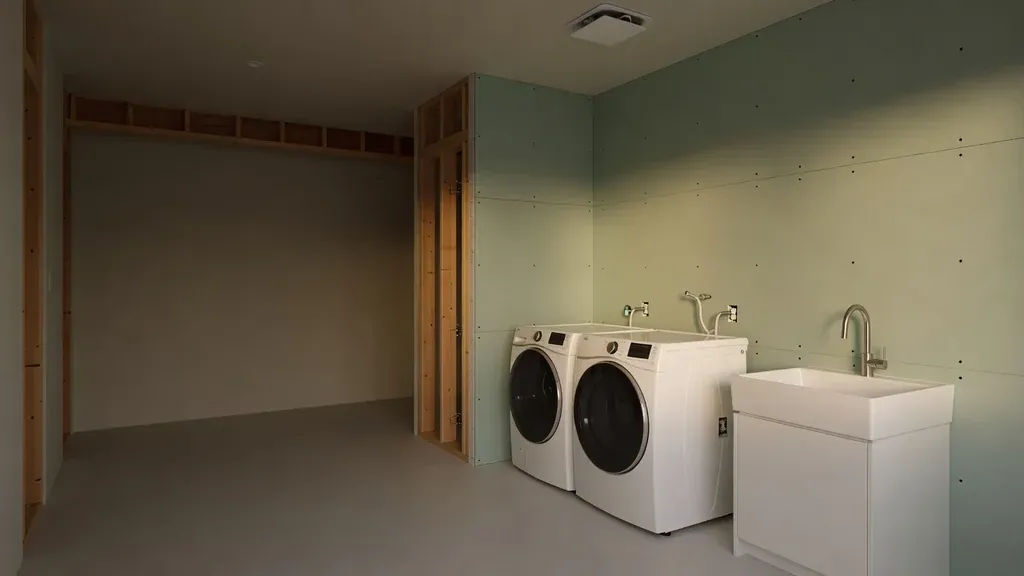
Mold-resistant drywall is a specialty gypsum panel intended to improve resistance to moisture and mold growth in appropriate interior conditions. That description matters. The panel is not waterproof, it does not remove moisture from a wall, and it does not make a leaking assembly safe to close.
The useful question is not simply whether a panel says “mold resistant.” The useful question is whether the water source is controlled, the cavity and framing are dry, the selected panel is approved for the location, and every layer around it belongs in the same assembly.
What Mold-Resistant Drywall Actually Changes
Mold-resistant products can use treated facings, moisture-resistant cores, fiberglass mats, or combinations of those features. Product claims vary. Some panels are intended for interior walls and ceilings with intermittent humidity. Others are designed for specific exterior, shaft, tile, or high-performance assemblies.
Manufacturers may report results under ASTM D3273, a laboratory test that evaluates resistance to mold growth on the surface of interior coatings. A strong test result is useful product information, but it is not a promise that mold can never grow in a real building.
Safety note: Never close a wet or contaminated cavity because the replacement board carries a mold-resistant label. Correct the source, follow appropriate assessment or remediation requirements, and verify that the assembly is ready to close.
The EPA’s mold and moisture guidance puts the priority in the right order: control moisture and dry wet areas quickly. A specialty panel supports that strategy. It does not replace it.
Match the Panel to the Exposure
The product data for the exact panel controls. Do not use color alone to identify an application. Green, purple, blue, or fiberglass-faced products can have very different limitations.
| Project condition | What to verify | Common mistake |
|---|---|---|
| Bathroom outside direct spray | Humidity, ventilation, panel approval, coating system | Treating the whole room as if every surface has the same exposure |
| Laundry or utility room | Leak risk, appliance connections, wall location, finish | Installing specialty board without correcting chronic condensation |
| Basement interior | Foundation moisture, vapor strategy, framing dryness | Closing a damp wall because the face of the board appears dry |
| Kitchen or sink wall | Expected splashing, backsplash system, product limits | Assuming ordinary paint makes the wall waterproof |
| Tub or shower enclosure | Approved backer, waterproofing, tile system, manufacturer details | Using interior mold-resistant drywall where direct-wet backer is required |
| Commercial restroom | Specification, occupancy, cleaning exposure, tested assembly | Substituting a product without checking plans and system listings |
USG’s product literature for several Mold Tough panels specifically notes that those products are not suitable as tile substrate in wet areas such as tubs and showers. Other systems may allow particular uses under particular details. The lesson is to read the selected product documentation, not to make a category-wide assumption.
Moisture Control Comes Before Board Selection
The EPA recommends drying water-damaged areas and items within 24 to 48 hours to help prevent mold growth. That timeline explains why a delayed response can change a small board replacement into a larger assessment.
Before drywall work begins, identify the source:
- Stop plumbing, roof, envelope, condensation, or appliance water.
- Determine how far the moisture traveled beyond the visible stain.
- Complete required drying, cleanup, or remediation.
- Inspect framing, insulation, backing, and adjacent materials.
- Decide which materials can remain and which need removal.
- Verify that the cavity is ready before installing new board.
The water-damage drywall repair service begins after source correction and readiness. Drywall replacement is reconstruction, not leak repair or mold remediation.
Installation Details Still Control the Finish
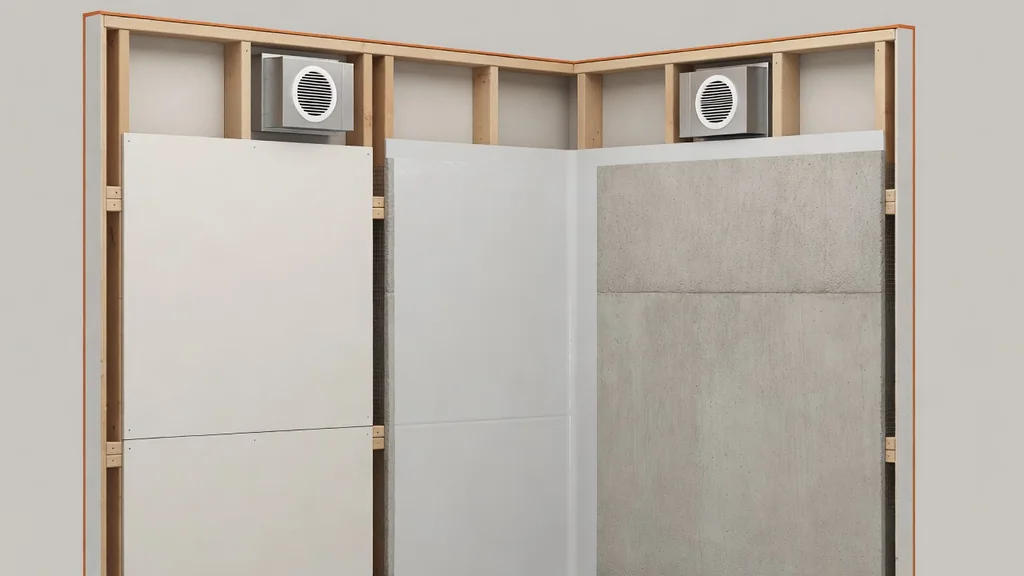
Once the location is ready, mold-resistant board still needs the same disciplined installation planning as other gypsum panels. Check framing alignment, backing, panel thickness, seam location, fastener requirements, openings, and edge support before hanging.
The sequence should follow the selected manufacturer instructions and any approved plans:
- Confirm panel type, thickness, dimensions, and orientation.
- Store panels flat and dry before use.
- Verify that framing and cavities are dry and ready.
- Plan seams away from weak or unsupported transitions.
- Cut openings accurately without damaging the facing.
- Fasten without breaking the face around screw heads.
- Use compatible tape, compound, corner products, primer, and coating.
- Respect drying time before sanding or coating.
The gypsum board installation guide covers layout and fastening in more detail. The drywall thickness guide explains why a repair or replacement must match the existing plane and any required assembly.
Direct-Wet Areas Need a Complete Wet-Area System
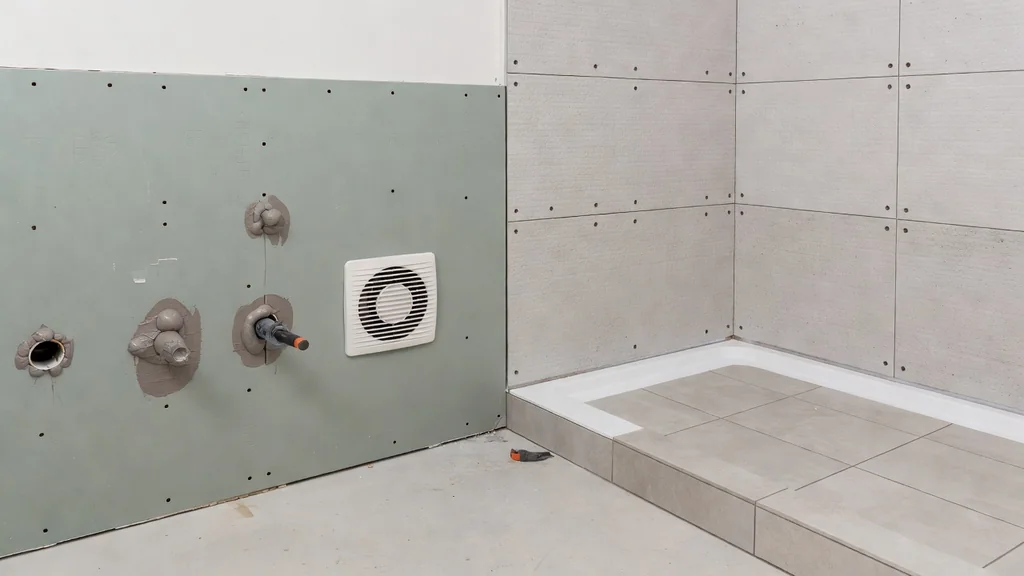
Mold-resistant drywall and tile backer are not interchangeable labels. A direct-wet area can require a specific backer, membrane, fasteners, seam treatment, penetrations, transitions, and tile installation method.
A panel that works on a bathroom ceiling may not be permitted behind tile inside a shower. A product permitted in one residential detail may not satisfy a commercial specification. Fire-rated or sound-rated assemblies add another layer: the complete listed system matters, including panel type, layers, fasteners, framing, insulation, joints, and penetrations.
Do not substitute a specialty board into a tested assembly based on a marketing label. Confirm the listed design, plans, specification, code requirements, and manufacturer documentation.
Repairing Existing Moisture Damage
Surface appearance alone does not define the repair boundary. Board can be soft beyond the stain. Fasteners can loosen. Paper can delaminate. Insulation and framing can remain damp after the visible face looks better.
Replacement is more likely when drywall is:
- soft, swollen, sagging, or delaminated;
- visibly moldy or connected to a contaminated cavity;
- repeatedly wet from an unresolved source;
- damaged through the face or core;
- unable to hold a stable patch; or
- part of an assembly that must be rebuilt to a defined detail.
A small dry opening with sound surrounding board may be repairable. The seamless patching guide explains backing, board fit, compound build, texture, and finish expectations after the material decision is made.
Finishing and Paint Matter Too
Mold-resistant board does not eliminate normal finish preparation. Joint compound, paper or fiberglass tape, corner products, primer, and paint must be compatible with the panel and exposure. Poor ventilation or coating before compound is dry can trap a weak condition under the finish.
Texture and paint matching can be included in the team’s scope when required. Existing color, sheen, texture profile, side lighting, and the age of the surrounding finish affect how the repaired plane reads after completion.
When sanding is required, the team plans tarps and appropriate dust-containment measures around the work area. Utah Drywall & Repair guarantees its workmanship on the drywall and finish scope identified in the estimate.
Frequently Asked Questions
Is mold-resistant drywall completely mold-proof?
No. It is designed to resist mold growth better than standard board under defined test conditions, but persistent moisture, contaminated dust, wet framing, and untreated leaks can still create problems.
Can mold-resistant drywall be used inside a shower?
Do not assume so. Many mold-resistant gypsum panels are not approved as tile backer in direct-wet shower and tub areas. Follow the selected product data and the complete approved wet-area assembly.
Should wet drywall be covered with new mold-resistant board?
No. Correct the water source, complete any required drying or remediation, and remove material that cannot remain before closing the assembly.
Does mold-resistant drywall change the finishing process?
The exact panel instructions control, but joints, fasteners, corners, drying, sanding, primer, and coating still need a compatible complete finish system.
When should a moisture-damaged wall be assessed on site?
Request an assessment when board is soft, swollen, visibly contaminated, repeatedly wet, connected to a hidden leak, or part of a larger wall or ceiling assembly.