Honestly, tackling a home renovation project can feel a bit overwhelming, especially when you are staring down a massive stack of bare sheetrock in your living room. But if you are a homeowner trying to patch up a Basement or finish a new room, getting the hang of cutting and measuring drywall is entirely doable. You just need a little patience, a sharp blade, and the right approach to make those seams fit together perfectly.
Contents
- 1 Why Drywall Isn’t as Scary as It Looks
- 2 The Tools You Actually Need (And What You Can Skip)
- 3 Measure Twice, Cut… Well, Score Once
- 4 Dealing with Outlets and Weird Cuts
- 5 The Art of the “Butt Joint” vs. the “Factory Edge”
- 6 Hanging the Stuff: A Few Insider Secrets
- 7 When to Call in the Pros (No Shame in It!)
Why Drywall Isn’t as Scary as It Looks
You know what? Most people look at a massive four-by-eight-foot sheet of drywall and assume they need a loud, heavy power saw to cut it. That is actually completely false. Here’s the thing—drywall is pretty much just compacted gypsum dust wrapped in heavy paper. It sounds tough, but it is surprisingly easy to manipulate.
I mean, sure, it is heavy and awkward to carry around, especially if you are hauling it down some narrow basement stairs here in Salt Lake County. But cutting it? That’s the easy part. It is really just an exercise in basic geometry and knowing how to handle a simple blade.
Wait, let me take a quick step back. I said it is easy, but it does require some precision. If you rush the measuring phase, you are going to end up with giant, gaping holes that will take buckets of joint compound (what us folks in the trade simply call “mud”) to fix. And trust me, nobody wants to spend their entire weekend Sanding down excess mud. It makes a colossal mess. It really does.
Plus, not all drywall is exactly the same. You might be working with standard half-inch boards for a bedroom, or maybe you bought some of that heavy, moisture-resistant “green board” for a bathroom project. The core is mostly the same, but the paper facing can feel a little different when you slice into it. Regardless of the specific type, the cutting concept remains exactly the same.
The Tools You Actually Need (And What You Can Skip)
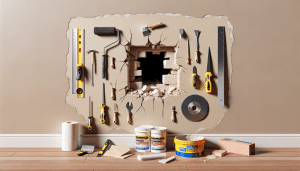
Before you run to the local hardware store and buy every shiny gadget on the shelf, let’s talk about what you actually need. Hardware aisles are full of specialty Drywall Repair tools, but for a standard home project, you can keep it simple. Let me explain. You do not need an expensive electric shear to get clean edges.
| Tool Name | Do You Need It? | What It Actually Does |
|---|---|---|
| Utility Knife | Absolutely | Used for the classic “score and snap” cutting technique. |
| Drywall T-Square | Highly Recommended | A massive metal ruler that gives you perfectly straight edges. |
| Drywall Router | Skip It (Mostly) | Cuts out holes for outlets. A simple keyhole hand saw works fine. |
Honestly, a fresh, sharp blade in your utility knife is your absolute best friend here. A dull blade will tear the drywall paper, leaving you with a ragged, fluffy edge that is a complete nightmare to finish later. Just buy a cheap pack of replacement blades and change them out the second they start pulling the paper instead of slicing cleanly through it.
Measure Twice, Cut… Well, Score Once
Okay, so how do you actually cut this stuff? If you have never done it before, the process feels a little unnatural. You do not saw through the board. Instead, you use a technique called scoring and snapping.
First, measure your space. Then, measure it again. Seriously, measure it twice. Our homes here in Utah settle quite a bit due to the crazy temperature shifts we get across Davis County and Utah County. That means your walls are probably not perfectly square. Never assume a corner is exactly ninety degrees, because it usually isn’t.
Here is the step-by-step breakdown of how to make a standard cut:
- Mark your measurements: Take your trusty Tape measure and mark your cut length with a pencil on the white paper side of the drywall.
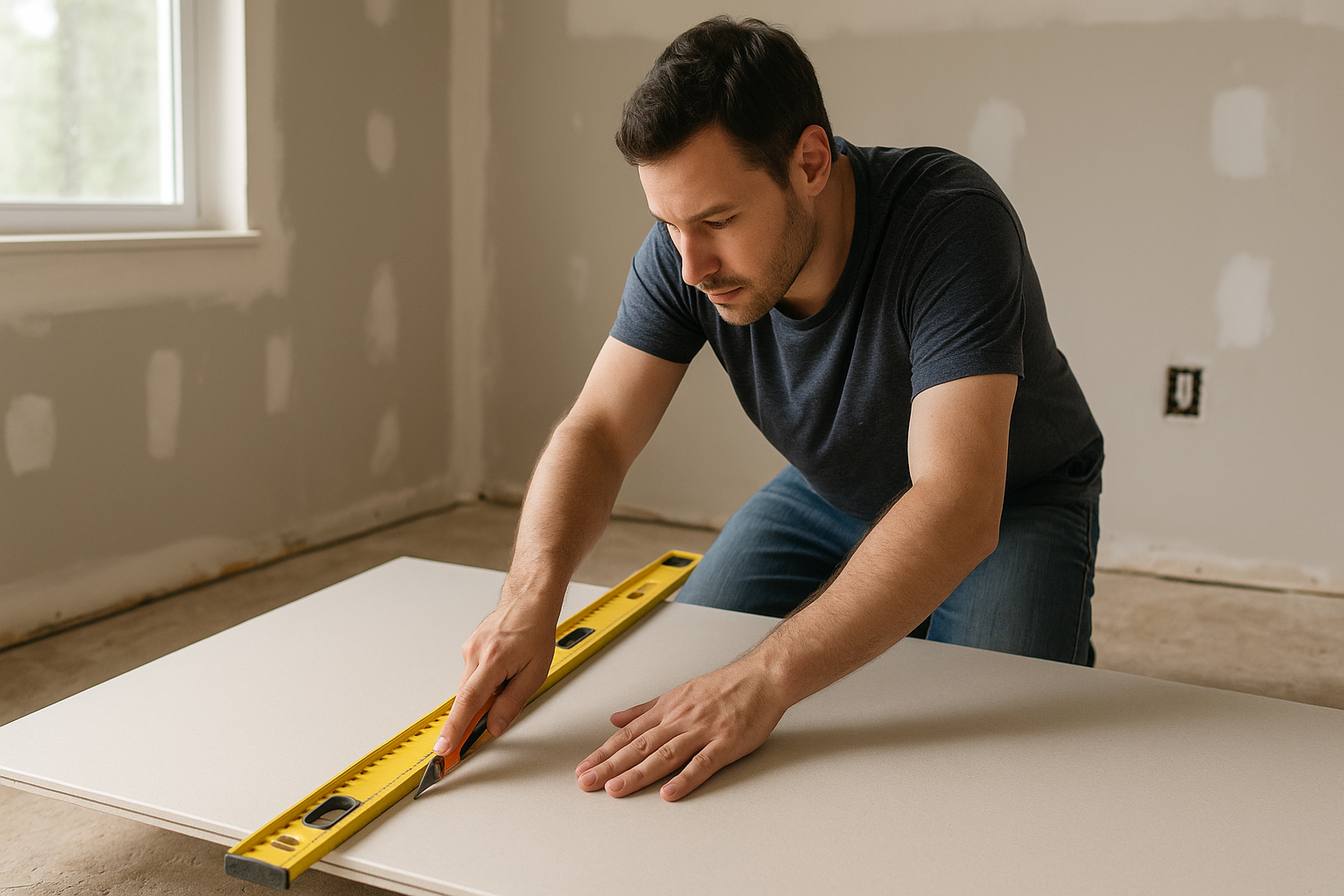
- Line up the T-Square: Place your drywall T-Square perfectly flush against the edge of the board to connect your marks.
- Score the paper: Run your utility knife firmly along the edge of the metal T-Square. You just want to cut through the front layer of paper and slightly into the chalky gypsum core. Do not try to cut all the way through the board!
- Snap the board: This is the fun part. Stand the board up, or slide it over the edge of a sturdy table, and firmly push back against the score line. It will snap cleanly in a perfectly straight line.
- Cut the backing paper: Fold the snapped piece back on itself, take your knife, and slice through the brown paper on the back hinge. Boom. You’re done.
It really is that simple. Once you get the rhythm down, you will be scoring and snapping full sheets in less than a minute.
Let me give you a quick warning, though. When you snap the board, it releases a little puff of fine white dust. If you are doing a bunch of cuts inside a closed room, that dust will linger in the air and eventually settle on everything you own. Try to set up your cutting station in the garage or outside on the driveway if the weather is nice. Your lungs, and your home’s furnace filter, will thank you later.
Dealing with Outlets and Weird Cuts
But what about the electrical outlets? Ah, yes. The dreaded outlet cutouts. How do you accurately cut a small rectangle in the middle of a giant, heavy sheet of drywall?
You could carefully measure the distance from the floor and the adjacent wall, transfer those exact coordinates to your sheetrock, and cut it out manually. Or, you can use an old contractor trick.
Take a cheap, brightly colored lipstick and rub it all over the front edges of the electrical box on the wall. Carefully lift your sheet of drywall into place and press it firmly against the wall right over the box. When you pull the board away, you will have a perfect, bright red lipstick stamp on the back of your drywall showing you exactly where to push your saw through.
Is it a little unconventional? Sure. But does it save you from completely ruining a twenty-dollar piece of sheetrock because your math was off by half an inch? You bet it does.
The Art of the “Butt Joint” vs. the “Factory Edge”
If you want your walls to look smooth, you need to understand the edges of the board. When you buy a sheet of drywall, the two long edges are slightly tapered. We call these the factory edges. They are tapered for a very specific reason. When you put two factory edges next to each other, it creates a shallow little valley. This valley gives you a place to pack your joint tape and mud so that the finished wall is perfectly flat.
However, when you cut a board yourself, you create a flat edge. If you put two flat cut edges together, it is called a “butt joint.” Butt joints have no valley. So, when you add tape and mud over a butt joint, you actually create a slight bump on the wall.
Whenever possible, try to keep factory edges together. If you absolutely have to create a butt joint, try to put it in a less noticeable area of the room, or be prepared to spread your joint compound out very wide to hide the bump.
Hanging the Stuff: A Few Insider Secrets
Now that you have your pieces cut to size, it is time to attach them to the wooden wall studs. This is where things get a bit heavy. Literally. A standard sheet of half-inch drywall weighs around fifty pounds. If you are doing a Ceiling, I highly recommend renting a drywall hoist from a local tool shop. Trying to balance fifty pounds of chalky rock above your head while awkwardly fumbling for a screw gun is just a bad idea. Trust me on that one.
When you are driving in your drywall Screws, the depth is everything. You want to drive the screw just far enough so that the head sinks slightly below the surface of the paper, creating a little dimple. But—and this is a massive “but”—you cannot break the paper. If the screw tears through the paper facing, it loses all its holding power, and that section of the board will eventually pop loose.
If you accidentally drive a screw too deep and break the paper, don’t panic. Just leave the bad screw there and drive a fresh one about an inch away. It happens to the best of us.
When to Call in the Pros (No Shame in It!)
Look, doing your own drywall installation can be super rewarding. It’s a great way to save a little money on a basement remodel or a garage finishing project. But let’s be entirely honest for a second. It is hard, dusty, backbreaking labor. And getting that perfectly smooth, ready-to-paint finish takes a lot of practice.
Sometimes, life just gets too busy, or a project turns out to be way bigger than you originally thought. Maybe you started cutting boards for a small patch job and realized the entire ceiling needs to be replaced. Or maybe you just despise sanding drywall mud. (And honestly, who could blame you? That dust gets everywhere.)
If you find yourself staring at a pile of half-cut sheetrock and thinking, “I really do not want to do this anymore,” that is totally okay. Whether you are up in Davis County, right here in Salt Lake County, or down south in Utah County, we have got your back.
At Utah Drywall & Repair, we live and breathe this stuff so you do not have to. We can handle everything from minor water damage patch jobs to full-scale home remodels, leaving you with flawless walls and zero cleanup anxiety.
Ready to hand off the heavy lifting and the dusty sanding to the experts? We are just a phone call away.