So, you’ve looked at those bare studs in your Basement or that accidental hole in the hallway and thought, “I can fix that myself.” It’s a rite of passage for homeowners from Sandy to Layton, really—taking raw materials and turning them into a finished room feels incredible, provided you don’t lose your mind in the process.
Contents
Is Drywall Really a DIY Job?
Here’s the thing. Hanging and finishing drywall—or Sheetrock, as we often call it—is one of those tasks that looks deceptively simple. You watch a fast-motion video on YouTube, and the guy spreads joint compound like he’s icing a cake. It looks satisfying. Easy, even. But ask anyone who has tried to finish a Ceiling in Utah County without a lift, and they’ll tell you a different story.
Honestly? It’s doable. Absolutely. But it requires patience, a bit of muscle, and the willingness to get covered in white dust.
If you are just Patching a hole from a doorknob accident, go for it. If you are finishing a 1,500-square-foot basement, you need to know exactly what you’re signing up for. The difference between a wall that looks like glass and one that looks like a topographical map of the Wasatch Front usually comes down to technique and patience.
Gathering Your Arsenal
You can’t do this with a hammer and a prayer. Having the right tools changes everything. It’s the difference between fighting the wall and working with the wall. You don’t need to buy the most expensive gear at the hardware store, but don’t scrape the bottom of the barrel, either.
Here is a quick breakdown of what you actually need to get the job done right.
| Tool | Why You Need It | Pro Tip |
|---|---|---|
| T-Square | For making straight cuts across the full 4-foot width of the board. | Don’t trust the factory edge to be perfectly square; always measure twice. |
| Drywall Screw Gun | Sets Screws to the perfect depth (dimpled, not broken). | If you don’t have one, get a “dimpler” bit for your standard drill. |
| 6, 10, & 12-inch Knives | You need varying sizes for feathering out the mud. | Stainless steel prevents rust. Rust in your mud is a nightmare. |
| Mud Pan | To hold your joint compound while you work up high. | Get a metal one with a sharp edge to clean your knife. |
| Sanding Pole | Saves your back and keeps your face away from the dust cloud. | Use a fine-grit screen; aggressive sanding ruins your work. |
Step 1: Hanging the Board (The Heavy Lifting)
Before you even think about mud, you have to get the board on the wall. In Salt Lake County, where building codes are strict about fire safety and insulation, make sure your framing is solid first. If the studs aren’t straight, your wall won’t be either.
Measure and Cut
Cutting drywall is actually the fun part. You score the front paper with a utility knife, snap the board back (it makes a satisfying pop), and cut the paper on the backside. Just be careful with your measurements. You want a snug fit, but not so tight that you have to sledgehammer it into place.
The Hanging Process
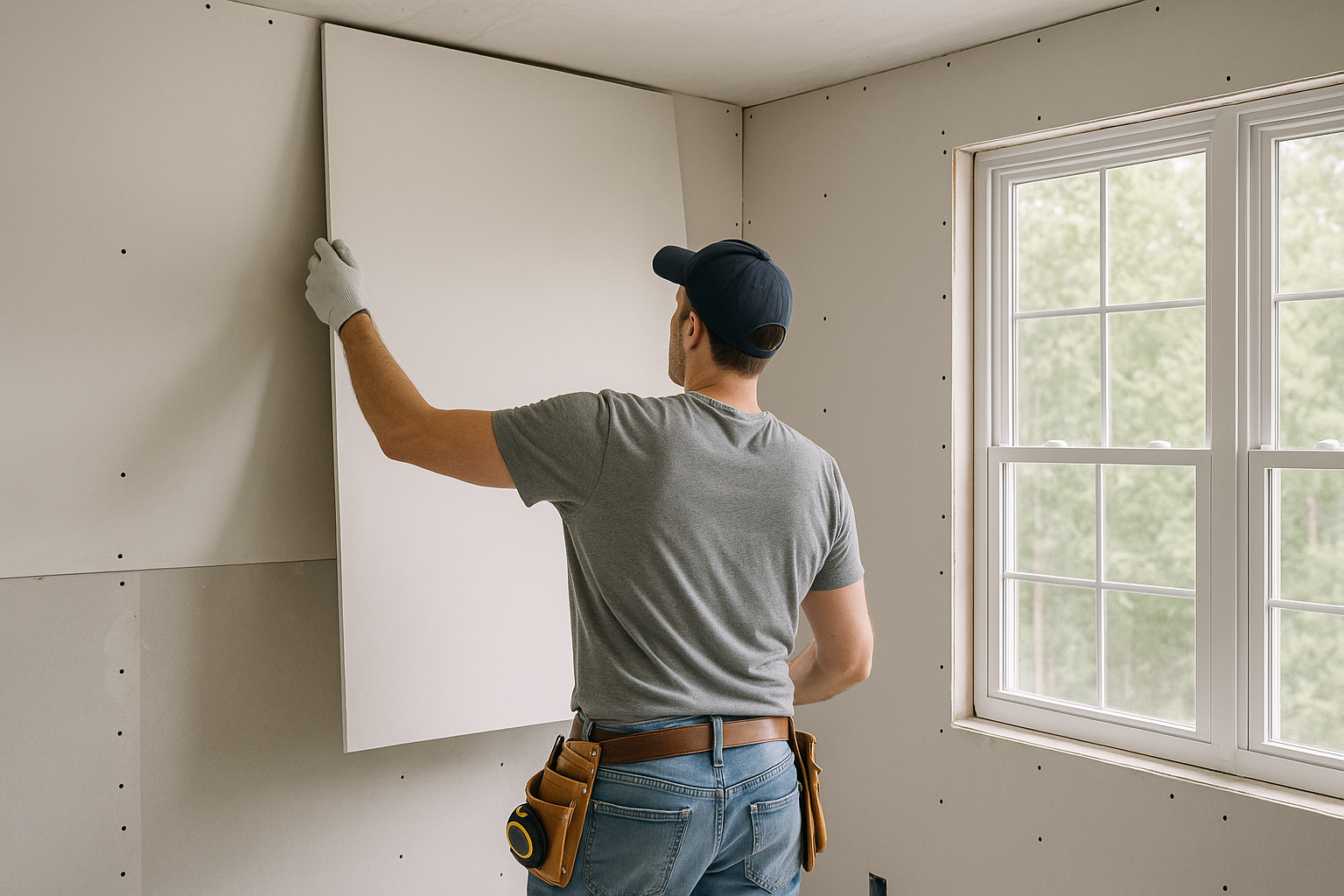
Start with the ceiling. Yes, I know, gravity is working against you here. If you are working alone, rent a drywall lift. Seriously. It costs a few bucks a day and will save your back.
When you move to the walls, hang the sheets horizontally. This reduces the linear footage of seams you have to Tape later by about 25%. Fewer seams mean less Mudding, and less mudding means less sanding. See where I’m going with this?
Screw It Down
Use coarse-thread drywall screws for wood studs. The goal is to sink the screw head just slightly below the surface of the paper without breaking the paper. It’s a “dimple.” If you break the paper, the screw loses its holding power, and that sheet might start rattling when your teenager slams a door three years from now.
Step 2: Taping and Mudding (The Art Form)
This is where the men are separated from the boys. Or, more accurately, where the patient people are separated from the frustrated ones.
The goal of taping and mudding is to make two separate sheets of gypsum look like one continuous surface. It’s an illusion. You aren’t just filling the crack; you are building a wider, gradual ramp over the seam so the eye can’t see the hump.
The Tape
You have two main choices: paper tape or mesh tape.
- Paper Tape: Stronger, but harder to use. You have to embed it in mud.
- Mesh Tape: Self-adhesive and easier for beginners, but you must use “hot mud” (setting-type compound) for the first coat to give it strength.
The Coats
- Embed Coat: Put mud in the joint, press the tape in, and wipe it flat. Let it dry completely. In our dry Utah air, this happens faster than in humid places, but give it time.
- Fill Coat: Use a larger knife (10-inch). Apply more mud over the tape, feathering the edges out. You aren’t trying to make it perfect yet; you’re just building structure.
- Finish Coat: Use your widest knife (12-inch). This is a thin skim coat to smooth out imperfections.
Rookie Mistake: Don’t pile the mud on thick hoping to sand it flat later. You will hate yourself during the sanding phase. Thin layers are better. It’s like Painting—three thin coats look better than one thick, drippy one.
Step 3: Sanding (The Messy Reality)
Get a mask. A good one. Not those cheap paper ones that leave gaps around your nose. Gypsum dust is incredibly fine; it gets into your lungs, your hair, and somehow inside the closed cabinets in the next room.
When you sand, use a light touch. You are trying to smooth the edges of the mud so they blend seamlessly into the paper. You are not trying to sand the mud off. If you see the tape showing through, you’ve gone too far. Stop immediately.
Pro Tip: Take a bright work light and shine it against the wall at a sharp angle (we call this “raking the light”). It will cast long shadows on even the tiniest bumps or scratches. If it looks good under a raking light, it will look amazing once it’s painted.
Step 4: Texture—The Utah Standard
If you look around homes in Davis County or Salt Lake, you rarely see perfectly smooth, flat walls (what pros call a Level 5 finish). Why? Because houses settle. The ground moves. Smooth walls show every tiny crack and imperfection.
Most homes here have some texture.
- Orange Peel: Looks like the skin of an orange. Subtle and common.
- Knockdown: Blobs of mud are sprayed on and then flattened with a wide knife. It feels a bit more “Old World” or rustic.
For a DIYer, spray cans of texture work for small patches. For whole rooms, you can rent a hopper gun. Just practice on a piece of cardboard first. The consistency of the mud matters a lot—too thick and it clumps; too thin and it runs down the wall.
Why My Wall Looks Lumpy
So, you finished. You primed. You painted. And now… there’s a hump.
It happens. Usually, this is because of “butt joints.” This is where the non-tapered ends of two drywall sheets meet. Unlike the long edges, which are thinner to accommodate tape, butt joints sit on top of the board. To fix this, you have to feather the mud out really wide—sometimes 12 inches or more on each side of the seam—to trick the eye.
It’s frustrating, isn’t it? You spend all weekend working, and the light hits the wall just right, and you see that seam.
When to Call in the Cavalry
Look, there is a lot of pride in doing it yourself. And for a garage or a small closet, it’s a great skill to learn. But drywall is one of those trades where the learning curve is steep and the physical toll is high.
If you are looking at a whole basement remodel, or you have high vaulted ceilings, or you just want walls that look like they were finished by a machine, it might be time to bring in help. Professional hangers and tapers can do in two days what might take a homeowner two weeks of evenings and weekends. Plus, we have the tools to keep the dust contained (mostly).
You don’t want to spend your entire Saturday fighting with heavy sheets of rock only to end up with wavy walls. If you want a flawless finish without the backache, we’re here to help homeowners all across the valley.
Ready to get those walls perfectly smooth?