Hanging drywall yourself usually sounds like a fun, satisfying weekend project right up until you’re awkwardly balancing a heavy sheet of gypsum board on your head while fumbling for your screw gun. Honestly, whether you’re Patching up a small water leak in your Salt Lake County home or framing out a massive Basement down in Utah County, dealing with sheetrock can get incredibly messy. Let me explain how you can navigate this dusty, heavy chore without completely losing your patience.
Contents
So, You’re Taking on the Drywall Hustle?
You know what? There is something genuinely rewarding about putting up your own walls. One minute you are staring at bare wooden studs, and the next, you have an actual room. It feels like real progress. But before we get to that perfectly smooth finish, we have to talk about the messy reality of sheetrock installation.
Here’s the thing. Houses move. They settle, they breathe, and here in Utah, the wild temperature swings mean your wood framing is constantly shifting. If you just slap some boards up without thinking about how they connect, you will end up with nasty cracks running down your walls by next winter.
That is exactly why installing drywall isn’t just about covering up insulation. It requires a bit of finesse. You need to mix professional techniques with some good old-fashioned elbow grease. I remember helping a buddy hang rock in his garage last summer. We thought we could just muscle it up there, but half an hour later, our shoulders were screaming. We quickly realized that working smart beats working hard every single time.
Gathering the Right Tools for the Job
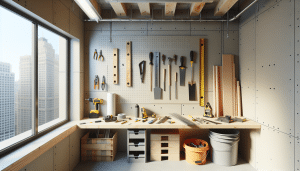
You cannot just attack this project with a hammer and a prayer. Having the right tools makes the difference between a smooth wall and a lumpy, frustrating mess. You don’t need to buy out the entire hardware store, but there are a few non-negotiable items.
- A solid utility knife: Forget saws. You score sheetrock and snap it. It is surprisingly satisfying, almost like breaking a giant piece of chalk.
- A drywall T-square: This is a massive ruler that helps you cut straight lines. Trust me, eyeballing it never works.
- A dedicated screw gun: Or at least a special dimpler bit for your regular drill. This prevents you from driving the Screws too deep and ripping the paper face.
- Mud pans and Taping knives: You will want a 6-inch knife for taping and a 10-inch or 12-inch knife for the wider finishing coats.
- A drywall lift: If you are doing ceilings, rent a lift. Do not try to hold a 50-pound panel over your head while trying to drill. Just don’t do it.
Hanging the Board: Where the Heavy Lifting Happens
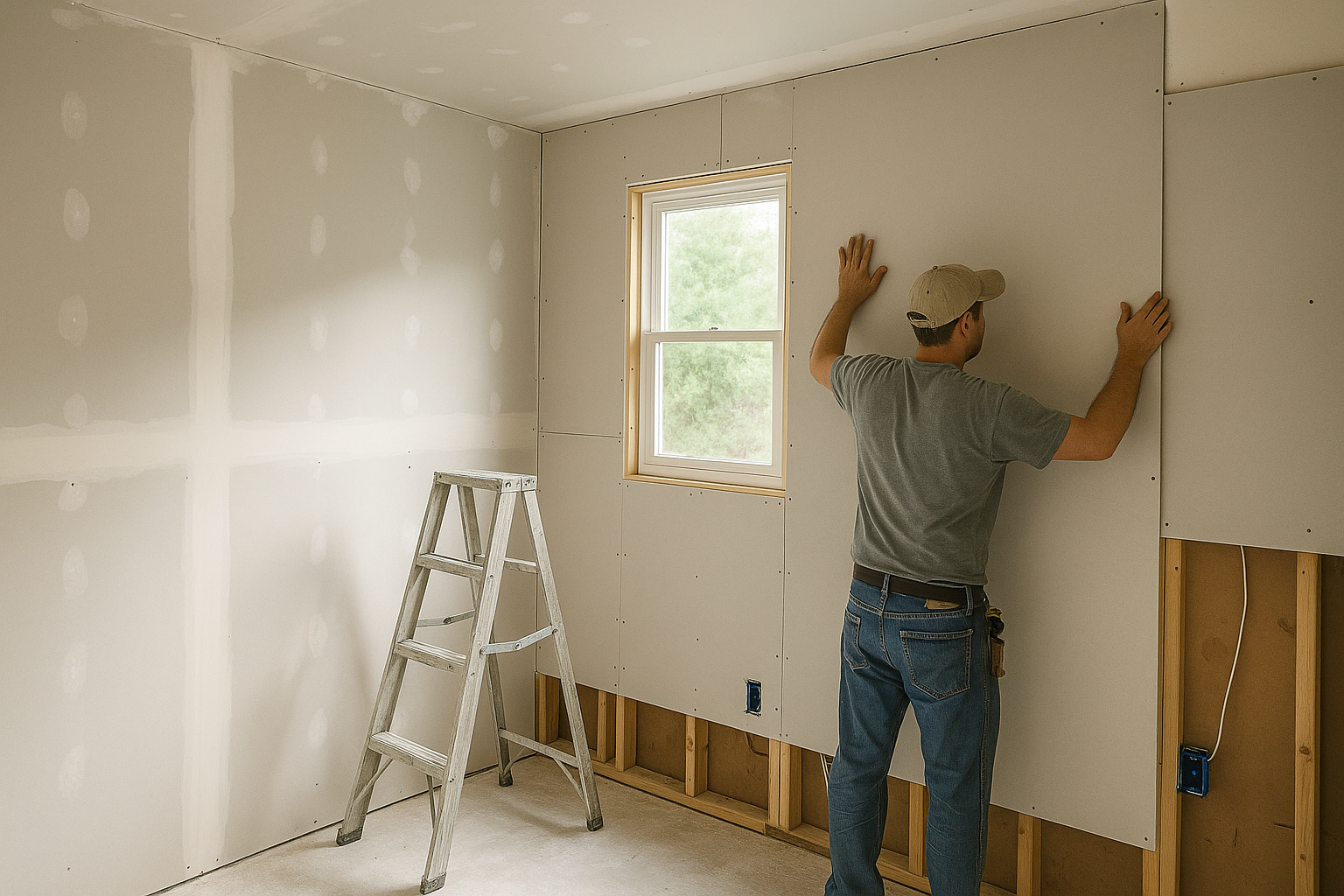
Alright, let’s talk about the physical part of the job. You always want to start with the Ceiling. Why? Because the wall pieces will eventually push up against the ceiling pieces, helping to support their weight. It is a neat little structural trick that saves your joints over time.
When you are hanging the drywall panels, you need to think about your seams. You want to stagger your joints, sort of like laying bricks on a house. If you line all your vertical seams up perfectly straight, you create a weak hinge across the whole wall. When the house shifts, that hinge will crack. Staggering the boards spreads out the tension evenly.
Also, pay close attention to the edges. Manufactured panels have tapered edges along the long sides. When you put two tapered edges together, it creates a shallow little valley. That valley gives your drywall Tape and mud a nice place to sit so the wall ends up completely flat. But when you cut a board, you lose that taper. You end up with what the pros call a “butt joint.” Butt joints are notoriously annoying to hide because you have to feather the joint compound out much wider to camouflage the inevitable bump.
Driving the fasteners is its own little art form. You want to dimple the screw. That means sinking the screw head just slightly below the surface of the paper without tearing the paper itself. If you break the brown paper layer, the screw loses all its holding power. It becomes basically useless at that point.
The Sticky, Dusty Reality: Taping and Mudding
Here is where your patience gets tested. Anybody can hang a board, but taping and finishing—that is where the real magic happens. Getting perfectly smooth walls takes practice, and honestly, it takes quite a lot of joint compound.
Let me explain the basic steps. First, you lay down a bed of mud and press your paper tape into it. You scrape off the excess, leaving just enough underneath to hold the tape flat against the wall. Then, you let it dry completely. Then comes the second coat to widen the joint and blend it out. Finally, you apply a thin top coat to smooth everything over.
Choosing the right mud can be incredibly confusing. You will walk into the home center and see bags of powder and buckets of pre-mixed paste. What is the difference? Let’s break it down simply.
| Type of Joint Compound | Drying Time | Best Used For |
|---|---|---|
| Hot Mud (Setting Type) | 20 to 90 minutes | Deep patches, first coats, filling big gaps. It dries rock hard via a chemical reaction. |
| All-Purpose (Pre-mixed) | 12 to 24 hours | Taping seams. It has lots of glue in it, so it sticks incredibly well to paper tape. |
| Lightweight Topping | 12 to 24 hours | The final top coats. It sands beautifully and leaves a smooth, finished surface. |
You will probably use a combination of these throughout your project. But remember this golden rule: put it on thin. You are not frosting a birthday cake. The more mud you slather on the wall, the more you have to manually sand off later. And Sanding is the absolute worst part of the job.
A Quick Word on Sanding (And Surviving the Dust)
I cannot stress this enough. Drywall dust gets everywhere. It will float through the air, travel through your HVAC vents, and somehow cover your toothbrush three rooms away. Tape off your doorways with heavy plastic sheeting. Wear a good quality dust mask.
When you sand, use a pole sander for the big areas and a flexible sanding sponge for the inside corners. Use a very light touch. You just want to knock down the ridges, not sand all the way back down to the paper tape. If you see the tape fuzzing up, stop immediately. You went too far.
To Texture or Not to Texture?
Once the sanding is finally over, you face another big decision. Do you leave the walls perfectly smooth, or do you add texture? Here in Utah, textured walls are incredibly popular. You see orange peel, knockdown, and sometimes even heavy trowel textures in older homes.
There is a very practical reason for this. Texture hides imperfections beautifully. If your mud job isn’t perfectly flat, a quick spray of orange peel texture will camouflage those minor sins. Smooth walls, on the other hand, require a much higher level of finishing. Every tiny scratch, bump, or shadow will show up on a smooth wall, especially if a large window casts sunlight across it at an angle.
Applying texture yourself usually involves renting a hopper gun. You mix the compound until it looks like pancake batter, pour it into the hopper, and spray it on. It is incredibly messy. You will look like a snow-covered statue by the time you finish. But watching the texture hit the wall and transform a flat board into a finished surface is deeply satisfying.
Knowing When to Throw in the Towel
Sometimes, a DIY project just becomes overwhelming. Maybe you successfully patched that hole from the doorknob, but now you are staring down a 1,500-square-foot basement remodel in Davis County, and sheer panic is setting in. That is completely normal.
Hanging large amounts of sheetrock is exhausting work. Getting the mud perfectly smooth on a giant vaulted ceiling requires years of muscle memory. There is absolutely no shame in realizing a project has outgrown your weekend availability. In fact, calling in a professional drywall contractor can actually save you money on wasted materials and save you weeks of living in a dusty construction zone.
If your walls look wavy, or if you simply value your free time, letting the experts take over is a smart move. Professionals have the specialized tools, the heavy-duty lifts, and the fast-drying compounds to knock out a massive room in a fraction of the time it takes a typical homeowner. Plus, you get the peace of mind knowing the finish will be flawless. No weird lumps hiding under your fresh paint. No mysterious cracks appearing six months down the road. Just clean, sharp, professional walls.
Ready to Skip the Heavy Lifting?
Tackling sheetrock is undeniably tough. It is heavy, it is dirty, and it demands a level of precision that can drive anyone a little bit crazy. Whether you tried to do it yourself and hit a wall—pun totally intended—or you just want to avoid the mess entirely, we are here to help. At Utah Drywall & Repair, we take immense pride in delivering perfectly smooth walls for homeowners across Salt Lake County, Davis County, and Utah County.
You don’t have to spend your precious weekends breathing in gypsum dust. Let us handle the heavy lifting, the tricky taping, and the endless sanding. Your home deserves a flawless finish, and you deserve a break.