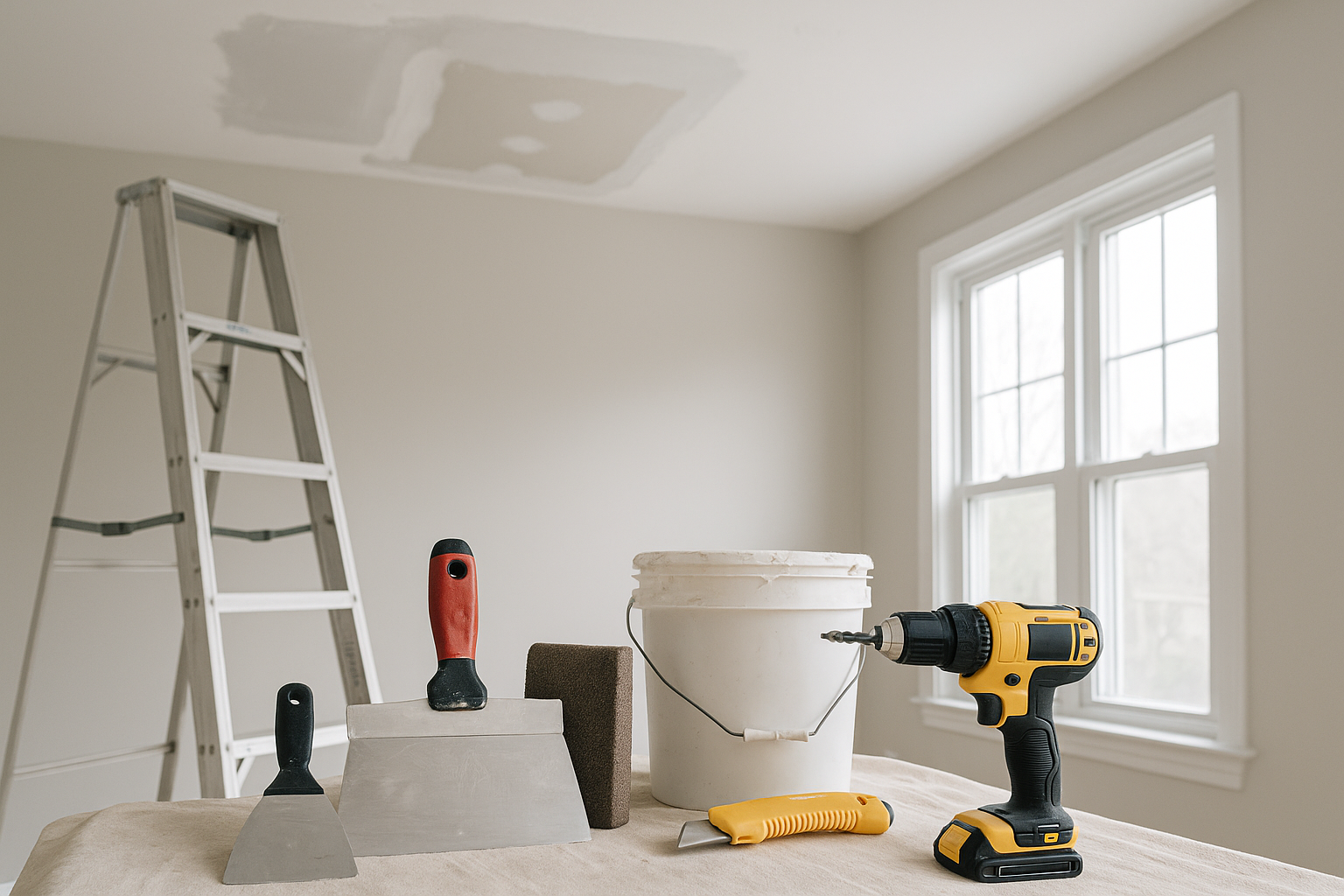
Staring up at that ugly water stain or accidental hole in your Ceiling is enough to ruin anyone’s weekend. Honestly, Patching drywall is notoriously messy work anyway, but tackling a ceiling Drywall Repair project is an entirely different beast that demands serious preparation. If you are determined to take on this overhead chore yourself, having the exact right tools isn’t just a casual suggestion—it’s the only way to keep your sanity intact.
Contents
Why Working Above Your Head Changes Everything
Let me explain something that most DIY tutorials gloss over. Fixing a wall at eye level is pretty straightforward, but the moment you point your hands toward the ceiling, gravity becomes your absolute worst enemy.
Everything falls. Your tools feel ten times heavier. Joint compound (the stuff we call “mud” in the trade) wants to plop directly onto your forehead. Because of this, you cannot afford to balance on a ladder while fumbling around for a tool you left on the floor.
You need to have everything prepped and ready to go before you even think about cutting into that ceiling. Having a solid, well-thought-out toolkit makes the difference between a seamless, invisible patch and a lumpy, highly noticeable eyesore that you will end up staring at every time you sit on the couch.
The Core Hardware: Your Cutting and Fastening Kit
Before you can patch a hole, you usually have to make it slightly bigger. I know, cutting away more ceiling sounds totally counterproductive. But you need clean edges to work with, which means you need the right cutting tools.
- A sturdy utility knife: Don’t just grab that rusty box cutter from the garage. You want a heavy-duty utility knife with a fresh, sharp blade. You will use this to score the drywall paper and create clean breaks.
- A drywall saw (Jab saw): This looks like a tiny dagger with nasty, aggressive teeth. It is specifically designed to punch through drywall and cut out damaged sections. Just be careful not to push it too deep, or you might slice into hidden electrical wires or plumbing pipes.
- A reliable cordless drill: You are going to need to attach your new piece of drywall to the wooden ceiling joists. A standard cordless drill from brands like DeWalt or Makita will do the trick perfectly.
- A drywall dimpler bit: This is a crucial little attachment. Let me be clear on this—do not skip the dimpler bit. When driving drywall Screws into the ceiling, the screw head needs to sit slightly below the surface of the paper without actually tearing the paper. A dimpler bit automatically stops the screw at the perfect depth.
Handling the Mud: Taping Knives and Pans
Here’s the thing. You can cut and screw drywall all day long, but the real artistry of Residential drywall patching comes down to how you handle the mud.
If you try to apply joint compound with a flimsy plastic putty knife you found at the bottom of a toolbox, you are going to have a bad time. You need a few specific tools to get that smooth, professional finish.
- A stainless steel mud pan: This is just a simple, rectangular trough to hold your joint compound while you work. Holding a pan in one hand while applying mud with the other is how the pros do it.
- A 6-inch taping knife: This is your workhorse for the initial stages. You will use the 6-inch blade to press drywall Tape into the seams and to scrape off the excess mud.
- A 10-inch or 12-inch finishing knife: You know what? This is where people usually mess up. They try to do the whole job with a tiny knife. To feather out the edges of your patch so it blends invisibly into the rest of the ceiling, you need a wide blade. The wider the knife, the smoother the transition.
Essential Materials for a Seamless Finish
You have the hardware, but what about the actual materials? Walk down the drywall aisle at your local hardware store, and the choices can be totally overwhelming.
| Material | What It Does | Pro Advice |
|---|---|---|
| Fiberglass Mesh Tape | Bridges the gap between the old ceiling and the new patch. | Great for beginners because it is self-adhesive. Sticks right to the ceiling. |
| Paper Tape | Creates stronger, more durable joints. | Harder to use overhead, but professionals prefer it for a truly flat finish. |
| Setting-Type Compound | Powdered mud you mix with water. Dries incredibly fast and hard. | Perfect for filling deep gaps. Look for “Easy Sand 5” or “20”. |
| All-Purpose Pre-Mixed Mud | Standard joint compound right out of the bucket. | Use this for your final, top coats because it is much easier to sand smooth. |
The Unsung Heroes: Dust Control and Safety Gear
We need to talk about the dust. Drywall dust is fine, powdery, and seemingly has a mind of its own. It will float through the air, travel through your HVAC system, and settle onto countertops three rooms away. It is awful.
Because you are working overhead, that dust is going to fall directly onto your face.
You absolutely must protect your eyes. A pair of wrap-around safety goggles is non-negotiable unless you enjoy trips to the eye doctor. Throw in a good quality P100 respirator mask, too. Inhaling gypsum dust is terrible for your lungs.
To protect your home, lay down heavy canvas drop cloths right below your work area. Plastic sheeting works in a pinch, but plastic gets very slippery when covered in drywall dust. Keep a heavy-duty shop vacuum with a high-quality HEPA filter nearby. Vacuuming as you sand will save you hours of deep cleaning later.
The Texture Challenge
You finally got the patch taped, mudded, and sanded perfectly smooth. It looks great! But wait—the rest of your ceiling is textured.
Matching ceiling texture is notoriously tricky. Whether you have a heavy knockdown, an orange peel finish, or a classic acoustic Popcorn ceiling, getting the new patch to match the old pattern requires a lot of patience. You might need texture sponges, aerosol texture spray cans, or even a hopper gun connected to an air compressor.
Honestly, blending texture is the number one reason homeowners throw their hands up in frustration and decide to call in a professional drywall repair company. It takes years of muscle memory to replicate a pattern so well that the human eye cannot spot the repair.
Knowing When to Call the Local Cavalry
DIY projects can be incredibly rewarding. Fixing your own home brings a real sense of accomplishment. But let’s be entirely realistic for a second.
Repairing a ceiling takes a toll on your neck, your shoulders, and your patience. If the hole is larger than a basketball, if there is extensive water damage, or if you simply do not have the time to spend a whole weekend covered in white powder, there is no shame in passing the baton.
Especially here in Utah, houses go through intense temperature fluctuations that can cause poor DIY patches to crack open again after just a few months. If you live anywhere in Salt Lake County, Davis County, or Utah County, you don’t have to tackle this messy project alone.
Sometimes the smartest tool in your entire arsenal is just your phone.
Let Us Save Your Weekend
Instead of spending your Saturday balancing on a ladder, dealing with falling debris, and trying to figure out why your joint compound won’t dry flat, let the experts handle it. At Utah Drywall & Repair, we have the tools, the techniques, and the experience to make that ugly ceiling hole completely disappear. We show up on time, protect your furniture, and blend the texture perfectly.
Stop staring at that ceiling and get your home looking flawless again.