You’ve probably stared at a bare, framed-out room in your Basement and thought, “How hard can putting up a few sheets of drywall really be?” Honestly, that’s exactly what most folks think right before they find themselves pinned against a wall by a crumbling 50-pound slab of gypsum. But getting those walls smooth, straight, and structurally sound doesn’t require magic—it just takes a few well-kept secrets from the guys who do it every single day.
Contents
- 1 Why Hanging Drywall Feels Like a Wrestling Match (And How to Win)
- 2 Hang It High: The Ceilings Always Go First Rule
- 3 The Right Arsenal (Because a Basic Hammer Won’t Cut It)
- 4 The Art of the Perfect Screw (Yes, It’s an Art)
- 5 The “Brickwork” Secret to Stronger Walls
- 6 Score, Snap, and Shave: Cutting with Confidence
- 7 Knowing When to Call the Utah Drywall Cavalry
Why Hanging Drywall Feels Like a Wrestling Match (And How to Win)
Let me explain something that most DIY tutorials gloss over. Drywall is incredibly heavy, weirdly fragile, and terribly awkward to hold. If you are tackling a renovation in a historic Salt Lake County home or just finishing an extra bedroom, you will quickly realize that manhandling a 4×8 sheet of Sheetrock is exhausting.
You know what? The real secret to efficient professional drywall hanging isn’t brute strength. It is meticulous planning.
Professionals never just grab a board and start throwing Screws into the studs. We measure the entire room first. We plan the layout to minimize joints, because every single seam you create is another seam you have to Tape, mud, and sand later. And nobody actually enjoys Sanding joint compound. By planning your cuts so that factory edges meet factory edges whenever possible, you save yourself hours of agonizing finish work.
It is also about working smarter with your layout. If you can use a 12-foot sheet instead of two 8-foot sheets, do it. Yes, it is heavier to carry into the house, but eliminating that extra vertical seam in the middle of your wall is absolutely worth the temporary shoulder burn.
Hang It High: The Ceilings Always Go First Rule
Here is the thing. If you take away only one piece of advice from this article, let it be this: always hang the Ceiling drywall before you touch the walls.
It seems a bit counterintuitive to some people. Why tackle the hardest, most gravity-defying part of the room first? You hang the ceiling first so the wall pieces can literally support the edges of the ceiling pieces. When you push that top wall sheet snug up against the ceiling, it creates a tightly locked corner that won’t crack when your house settles.
Speaking of settling, homes along the Wasatch Front shift all the time. The temperature swings from freezing winters to baking summers cause the wood framing in your home to expand and contract. If your drywall joints are sloppy, those temperature shifts will cause ugly hairline cracks across your ceiling in a matter of months.
- Rent a drywall hoist. Just do it. Trying to hold a ceiling panel over your head with a 2×4 “deadman” prop while fumbling for your screw gun is a recipe for a dropped board and a massive headache.
- Mark your joists. Before you lift the board, use a pencil to mark the ceiling joist Locations on the top plates of the framing. Once the drywall covers the wood, you won’t be able to see where to drive your screws.
- Work across the joists. Always hang your ceiling panels perpendicular to the framing joists. This makes the entire ceiling structure much stronger and reduces sagging over time.
The Right Arsenal (Because a Basic Hammer Won’t Cut It)
You can always spot an amateur drywall job by the tools scattered across the floor. If you are relying on a standard tape measure, a dull box cutter, and a regular cordless drill, you are making the job twice as hard as it needs to be.
To achieve a true seamless wall finish, you need gear designed specifically for the quirks of gypsum board. The right tools make the process surprisingly fast and significantly less frustrating.
| Essential Tool | What It Does | The Pro Upgrade |
|---|---|---|
| T-Square | Ensures perfectly straight cuts across the full 4-foot width of the board. | An aluminum, adjustable 48-inch drywall T-square. |
| Screw Gun | Drives screws to the exact right depth every single time without tearing paper. | A collated DeWalt or Makita drywall screw gun. |
| Rasp | Smooths out rough, jagged edges after snapping a cut piece of drywall. | A Surform pocket plane for fast edge shaping. |
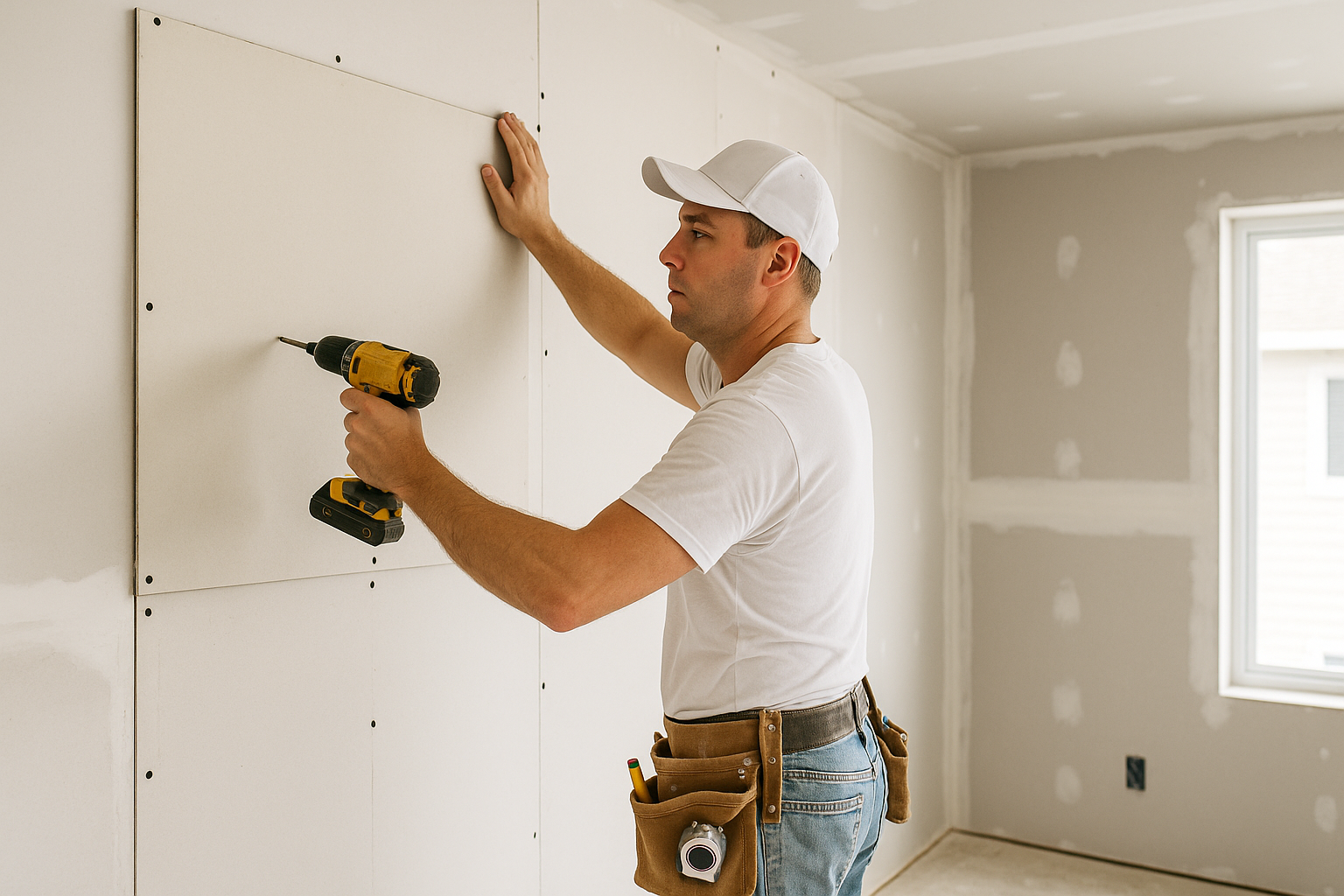
Using a dedicated drywall screw gun is probably the biggest game-changer. Standard drills are great for building decks, but they lack the sensitive clutch needed for drywall. A proper screw gun automatically stops driving the screw the millisecond it reaches the perfect depth.
The Art of the Perfect Screw (Yes, It’s an Art)
There is a very specific language of screws and studs in the drywall trade. Most homeowners do not realize that the structural integrity of the entire wall depends heavily on the paper facing of the drywall. The gypsum core is just chalky rock; the heavy paper on the outside is what actually holds everything together.
When you drive a screw into the wall, you want to achieve what professionals call “dimpling.”
You need the head of the screw to sit just slightly below the surface of the paper, creating a tiny little crater or dimple. But—and this is a massive but—you absolutely cannot tear the paper. If the screw rips through the paper and bites into the white gypsum core, that screw is basically doing nothing. It has lost all its holding power.
If you leave the screw “proud” (meaning it sticks out above the paper even a fraction of a millimeter), your Taping knife will loudly click against it later, and you will never get a smooth wall.
- Keep your spacing tight. Screws should be placed every 16 inches on walls and every 12 inches on ceilings.
- Keep away from the edges. Never drive a screw closer than 3/8 of an inch from the edge of the board, or the fragile edge will just crumble and break away.
- Sink a backup. If you accidentally sink a screw too deep and break the paper, don’t pull it out. Just leave it there and drive another screw about two inches away to the proper depth.
The “Brickwork” Secret to Stronger Walls
Have you ever noticed how bricklayers never stack bricks in perfectly straight vertical lines? They stagger them. They overlap the joints to give the wall sheer strength. Professional drywall installation works exactly the same way.
We never, ever line up vertical seams. If you have a vertical joint between two sheets of drywall on the bottom half of your wall, the joint on the top half needs to be offset by at least one full framing stud. This staggering technique prevents continuous cracks from forming straight down your wall.
I should also mention doors and windows. This is a classic rookie mistake. People often hang drywall so that a seam lines up perfectly with the vertical edge of a door frame. You really, really don’t want to do that. Every time that door slams, the vibration travels up the framing stud. If there is a drywall seam sitting right there, it will crack the joint compound within a year. Always cut your drywall around the openings so the seams fall at least six inches away from the corners of doors and windows.
Score, Snap, and Shave: Cutting with Confidence
Hanging drywall produces dust. There is no escaping it. But you can drastically reduce the mess by cutting the boards correctly. You rarely actually cut all the way through a sheet of drywall. You score it, and you snap it.
Grab a sharp utility knife—and I mean a fresh, razor-sharp blade. Run your knife down the front paper face of the board, using your T-square as a guide. You don’t need to press impossibly hard; you just need to slice cleanly through that top layer of paper.
Once the paper is scored, apply a little pressure to the back of the board. It will break cleanly along the line you just cut, with a really satisfying snap. Then, just run your knife down the crease on the back to slice the rear paper.
If your newly cut edge is a little bumpy, give it a quick pass with your drywall rasp. A smooth edge makes fitting the boards together so much easier, especially when you are wrestling with a tight fit around an electrical outlet or a tricky Davis County basement window well.
Knowing When to Call the Utah Drywall Cavalry
Hanging the boards yourself can definitely save you some money on your renovation project. But as you have probably gathered by now, it is a labor-intensive, physically demanding job that requires a serious eye for detail. A bad hanging job guarantees a terrible taping and Mudding job. The mud cannot fix severely mismatched joints, gaping holes, or walls that look like rolling ocean waves.
Sometimes, your time and your sanity are simply worth more than the cost of DIY. Whether you are dealing with a complex vaulted ceiling in Utah County, repairing extensive water damage in Salt Lake, or finishing a massive basement in Davis County, bringing in a seasoned crew ensures the foundation of your walls is absolutely flawless.
If you are tired of looking at exposed studs, or if you just realized that wrangling heavy sheets of drywall isn’t your idea of a fun weekend, we are here to help. At Utah Drywall & Repair, we handle the heavy lifting, the precision cutting, and the messy mudding so you can just enjoy your beautiful new space.