Let’s be honest, staring at a dent, ding, or glaring hole in your wall every single day is enough to drive anyone crazy. Whether it was a rogue doorknob, a teenager moving furniture, or just a stubborn nail pop, damaged drywall practically begs for attention. Patching a hole might not be rocket science, but making that patch completely disappear?
Contents
- 1 Why Is Hiding a Wall Patch So Ridiculously Hard?
- 2 The Secret Sauce: Don’t Skimp on the Hardware
- 3 Mesh or Paper? The Great Tape Debate
- 4 Slapping on the Mud (And Smoothing It Out)
- 5 The Climate Curveball: Drying Times
- 6 Sanding Without Losing Your Mind
- 7 The Final Illusion: Texture and Paint
- 8 Ready to Reclaim Your Walls?
Why Is Hiding a Wall Patch So Ridiculously Hard?
Here’s the thing about professional plasterboard fixing—it is essentially a magic trick. Anyone can buy a tiny tub of pink spackle, smear it roughly into a hole, and call it a day. But when the sunlight hits that wall in the late afternoon, that amateur patch will stick out like a sore thumb.
If you live around here, you already know our homes take an absolute beating from the weather. The extreme temperature swings from brutal winters to blazing summers across Salt Lake County and Davis County cause our houses to expand, contract, and settle constantly. This ongoing structural movement leads directly to stress cracks above doorways and those incredibly annoying nail pops.
You know what? I actually think nail pops are more frustrating than actual holes. A hole has a clear story; maybe you were moving a couch. A nail pop just makes it look like your living room is slowly falling apart.
Fixing these wall imperfections requires a mix of the right materials, precise timing, and a good amount of patience. If you rush the drying process or skip the primer, your wall will eventually show a dull, flat spot where the repair happened—a common problem professional painters call “flashing.” So, let me explain exactly how the pros make wall damage vanish completely without leaving a trace behind.
The Secret Sauce: Don’t Skimp on the Hardware
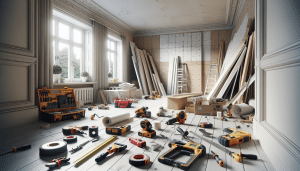
If you want truly professional results, you cannot rely on that flimsy plastic putty knife sitting in your kitchen junk drawer. High-quality Drywall Repair starts exclusively with the right gear. Professional drywallers—often affectionately called “mud slingers” in the building trades—use highly specific tools that make spreading and smoothing joint compound significantly easier.
| The Tool | Pro Terminology | What It Actually Does |
|---|---|---|
| 6-inch & 10-inch Knives | Taping Knives | Spreads the joint compound wide to blend the patch into the surrounding wall seamlessly. |
| Joint Compound | “Mud” | The gypsum-based paste used to fill gaps, cover wall Tape, and smooth over holes. |
| Sanding Sponge | Mud Scrubber | A flexible, abrasive block perfect for smoothing out dried compound without tearing the drywall paper. |
Honestly, just upgrading your taping knife from a cheap 2-inch plastic blade to a flexible 6-inch metal knife will instantly improve your patching game. A wider blade lets you flatten the edges perfectly. We will talk about feathering edges in just a minute, but trust me, it is the holy grail of invisible patching.
Mesh or Paper? The Great Tape Debate
When you fix a larger hole or a long Ceiling stress crack, you absolutely must reinforce the joint. If you just shove wet mud into a crack without taping it first, that crack will return within a few weeks. It is virtually guaranteed.
Walk down the paint aisle of any hardware store in Utah County, and you will quickly see two main options: fiberglass mesh tape and traditional paper tape.
- Paper tape is the undisputed champion for professional, long-lasting strength. It creates crisp, clean inside corners and holds up incredibly well against the natural shifting of a settling house.
- Fiberglass mesh tape is sticky on one side, making it super easy to apply straight to the wall for beginners. It looks exactly like a little white grid.
- The catch with mesh is that it is physically thicker than paper tape and slightly more prone to cracking if you do not use a specialized setting-type compound (often called hot mud).
So, which one should you choose? For small, flat wall patches where structural movement is minimal, mesh tape is usually fine and much less frustrating to handle. But for corners, deep holes, or large structural seams, paper tape is exactly what a plasterboard fixing professional would use every single time.
Slapping on the Mud (And Smoothing It Out)
Now we get to the messy, fun part. Mudding.
Applying joint compound is all about laying down multiple thin layers instead of one massive, thick blob. I see this specific mistake all the time. Homeowners load up their putty knife, spackle the hole until it bulges out an inch from the wall, and assume they will just sand it flat later. Do not do this. It creates an enormous mess and wastes hours of your precious time.
Instead, you want to “feather” the edges.
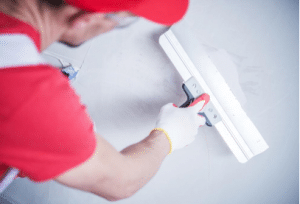
Let me explain how feathering works. When you apply the wet mud over your patch, you press harder on the outside edges of your knife than you do in the middle. This physical technique tapers the compound down to practically nothing where it meets the original, undamaged wall.
By your second or third coat of mud, you should be using a 10-inch or even a 12-inch taping knife to spread that repair area out wide. It sounds completely counterintuitive, right? Why make a small patch bigger?
We make the patch wider to trick the human eye. By spreading the compound over a much larger surface area, the physical transition from the patch to the original wall becomes incredibly gradual. A gradual, gentle slope is invisible; a sudden, steep bump is obvious from across the room.
The Climate Curveball: Drying Times
Here is a quick digression about our local environment that actually matters a lot. Living in the Mountain West means we deal with bone-dry air year-round. When you spread joint compound in a typical house out here, that dry air acts exactly like a sponge. It pulls moisture out of the wet mud rapidly.
Usually, this is a very good thing! Fast drying means you can get to the sanding phase much quicker. But if you apply the mud too thick, the outside crust dries fast while the inside stays wet and mushy. As the inside finally dries days later, the patch will actually shrink inward and crack right down the middle. This is exactly why multiple thin layers are the true secret to success. Apply a thin coat, let it dry entirely, scrape off any high spots with your knife, and then apply the next layer. Patience is your best friend here.
Sanding Without Losing Your Mind
Sanding is the most critical step for an invisible repair. Actually, wait, laying the mud perfectly flat in the first place is probably the most critical step—but sanding is definitely where most well-meaning homeowners completely ruin their hard work.
Dry sanding creates a notoriously fine, powdery white dust that floats through the air and settles on literally everything you own. It gets inside your air vents, covers your television screen, and ruins your entire afternoon.
To avoid creating an indoor snowstorm, you can try wet sanding. Take a specialized drywall sanding sponge, get it slightly damp with warm water, and gently rub the edges of your dried mud. The damp sponge melts the harsh edges of the joint compound into the surrounding wall without creating a single speck of airborne dust. Wet sanding does not leave the surface quite as glass-smooth as dry sanding, but for textured walls, it works absolute wonders.
If you must dry sand, use a fine-grit block (around 120 or 150 grit) and sand with very light pressure. Remember, you are just smoothing the very top surface; you are not trying to aggressively sand away all the compound you just painstakingly applied.
The Final Illusion: Texture and Paint
You made it to the finish line. The wall is patched, perfectly smooth, and completely dry. You are ready to slap some interior paint on it and forget the hole ever existed.
Hold on a second.
Before you open that paint can, look very closely at your wall. Does it have a slight bumpy texture? Most homes in Utah feature either a subtle “orange peel” texture or a heavier, flattened “knockdown” texture. If you paint a perfectly smooth patch on a heavily textured wall, it will look exactly like a bald spot. You can buy aerosol texture spray cans at the local hardware store to match your existing finish perfectly. Practice spraying on a piece of scrap cardboard first to get the pattern right.
Once the new texture is completely dry, you absolutely must use a primer. Joint compound is highly porous by nature. If you roll standard wall paint directly over bare mud, the patch will absorb the paint differently than the rest of the sealed wall. The final finish will look noticeably flat and dull. A quick coat of primer seals the pores completely, ensuring your final topcoat blends flawlessly.
Ready to Reclaim Your Walls?
Sometimes, a repair job is just a little too big, a high ceiling patch is too awkward to reach, or you simply do not want to spend your entire weekend covered head-to-toe in white dust. We completely understand. Fixing walls is a specialized craft that takes years to master, and trying to handle major structural damage on your own can quickly turn into a frustrating headache.
When you want a perfectly seamless finish without the hassle, bring in the local experts. Our team at Utah Drywall & Repair specializes in making Residential damage completely vanish, whether you are dealing with minor furniture dents, severe water damage, or major Remodeling seams. We treat your home with total respect, leaving behind nothing but flawless, paint-ready walls.
Stop staring at that ugly hole in your living room wall. Give us a call at 801-406-6350 today, or click to Request a Free Quote. Let’s get your home looking perfect again.