Looking up at those bumpy, dust-collecting textures might feel like staring into the past, right? If you own an older home here in Utah—whether it’s a bungalow in Salt Lake or a split-level in Bountiful—chances are you’ve thought about scraping that stuff off at least a dozen times. Let’s talk about whether getting rid of that acoustic texture is actually worth the headache or if you’re opening a can of worms you might regret.
Contents
So, why does everyone hate this stuff anyway?
Honestly, it wasn’t always this way. Back in the mid-20th century, Contractors loved Popcorn ceilings. It was the ultimate cheat code for home builders. You could slap up some drywall, do a mediocre Taping job, and then spray this thick, bumpy texture over everything to hide the imperfections. No need for a smooth skim coat or precision Sanding. It was fast, cheap, and supposedly dampened sound (hence the name “acoustic Ceiling“).
But here we are decades later, and the vibe has definitely shifted.
The biggest gripe homeowners have isn’t even the look; it’s the maintenance. Have you ever tried to clean a popcorn ceiling? It’s a nightmare. You take a duster to a cobweb in the corner, and suddenly it’s raining little white pebbles all over your carpet. Plus, that rough texture is a magnet for dust and shadows, making rooms feel smaller and darker than they actually are.
And let’s be real for a second—Painting it is even worse. The texture sucks up paint like a sponge, and if you roll it too hard, the popcorn starts peeling off onto your roller. It’s frustrating.
The Elephant in the Room: Asbestos Risks
Here is the thing, and this is the part where we have to get a little serious. Before you go running to the hardware store for a scraper and a ladder, you need to look at the age of your house.
If your home was built before the early 1980s, there is a very real chance your ceiling texture contains asbestos.
Asbestos was a standard ingredient in Texturing materials because it was fire-resistant and helped bind the mix together. It wasn’t until 1978 that the federal government banned its use in spray-on compounds, but builders were allowed to use up their existing inventory. That means homes built as late as the early 80s in places like Provo or Sandy could still be affected.
Why is this a risk?
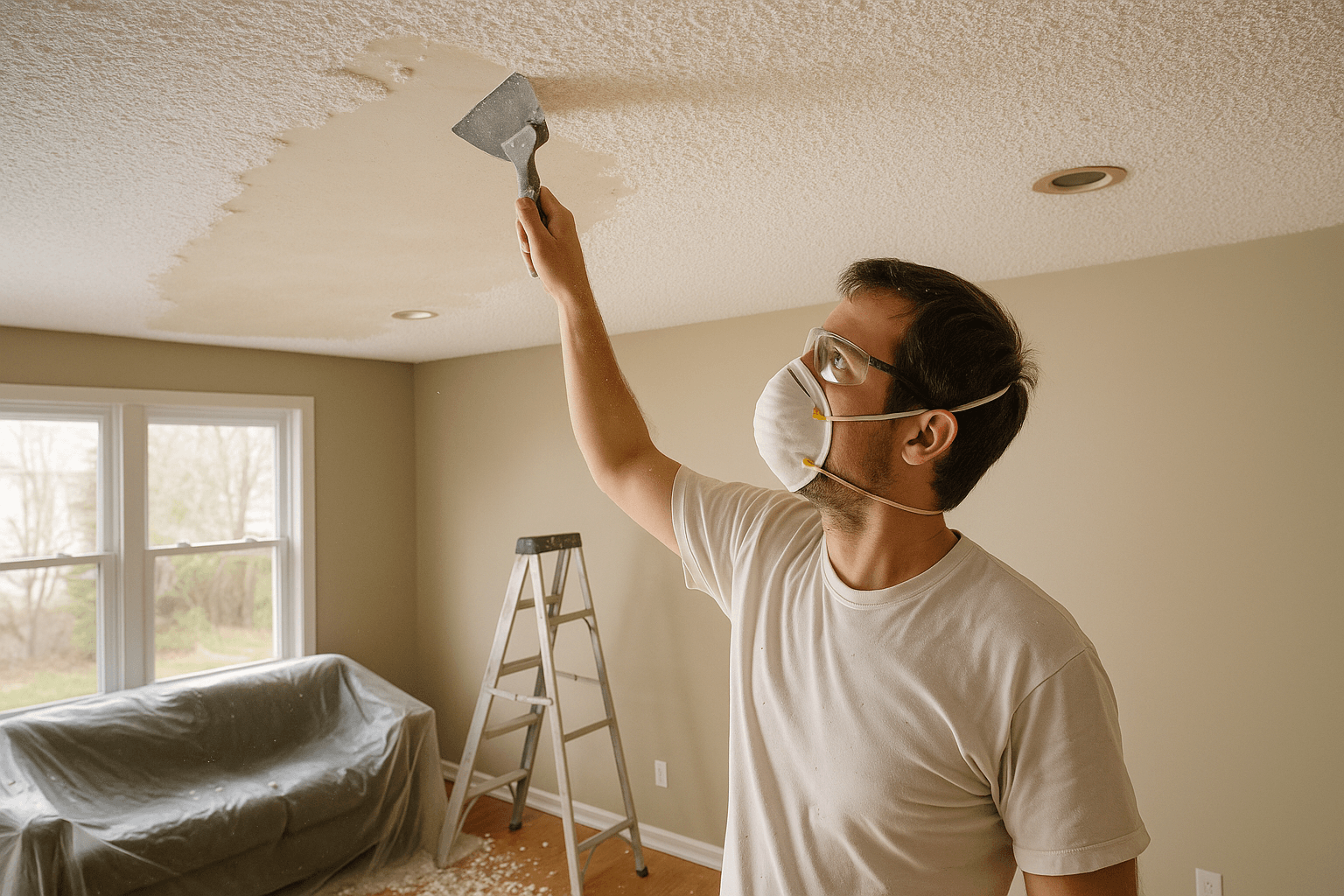
When asbestos is sitting there on your ceiling, undisturbed, it’s generally not a threat to your health. The danger happens when you disturb it. Scraping, sanding, or even aggressively cleaning it releases microscopic fibers into the air. If you breathe those in, they can cause serious lung damage down the road.
If your house fits that timeline, you cannot just go at it with a scraper. You need to get a sample tested first. It’s a small price to pay for safety.
It’s not just scraping; it’s a mud bath
Let’s assume your ceiling is safe, or your home is newer. You might be thinking, “Okay, I’ll just wet it down and scrape it off. Easy weekend project.”
Well, not exactly.
Removing the texture is actually the easy part. The real work starts once the popcorn is on the floor. Underneath that texture, the drywall finish is usually pretty rough. Remember, the builder used the popcorn to hide a bad Tape job. Once you expose the naked drywall, you’re going to see seams, nail holes, and gouges from your scraper.
To get that smooth, modern look, you have to move into drywall finishing. This involves:
- Sanding down rough spots (and creating a dust storm).
- Applying multiple coats of joint compound (or “mud”).
- Skimming the entire surface to make it level.
- Sanding again. And again.
It is messy. Like, really messy. Wet drywall mud gets everywhere. If you don’t seal off the room with plastic like a crime scene, you’ll be finding white dust in your kitchen cabinets three rooms away for the next six months.
DIY vs. Hiring a Pro: A Reality Check
I see a lot of people in Davis County try this as a DIY project, and usually, about halfway through the living room, regret sets in. It’s incredibly physical work. You are working with your arms above your head for hours, straining your neck and shoulders.
If you are on the fence about tackling this yourself or calling in a crew like ours, here is a quick breakdown of what to expect:
| Feature | DIY Approach | Professional Removal |
|---|---|---|
| Time Commitment | Several weekends (scraping, Mudding, drying, sanding) | 1-3 days depending on square footage |
| Equipment Needed | Scrapers, sanders, ladders, tarps, PPE, shop vacs | We bring everything (and take the trash with us) |
| Finish Quality | Often wavy or uneven without high-level skill | Smooth, Level 4 or Level 5 finish ready for paint |
| Mess Factor | High stress; dust management is difficult | Containment zones used to protect your furniture |
There is also a nuance here regarding the “finish.” Achieving a perfectly flat ceiling is an art form. When you shine a light across a ceiling, every single ripple shows up. Professionals use wide blades and specific sanding techniques to ensure that when you turn on the lights, it looks like a sheet of glass, not a topographical map.
Is the juice worth the squeeze? (The Rewards)
We’ve talked about the mess and the risks, so let’s talk about the good stuff. Why do people do this?
1. Instant Modernization
Nothing dates a house faster than popcorn. Removing it instantly makes the home feel 20 years younger. It’s a subtle change that completely alters the “feel” of the space.
2. Better Lighting
Smooth ceilings reflect light much better than textured ones. Popcorn texture absorbs light and creates tiny shadows everywhere. Once it’s gone, you’ll notice your rooms feel brighter and airier, even with the same light bulbs.
3. Increased Home Value
If you are planning to sell your home in Salt Lake or Utah County anytime soon, this is one of the best ROI projects you can do. Buyers hate popcorn ceilings. They see it as a project they will have to do later. By taking care of it, you remove a major mental barrier for potential buyers.
4. Easier Maintenance
This one is simple. A smooth, painted ceiling can be dusted or wiped down. No more crumbling white specks.
What about the texture alternatives?
You know what? You don’t always have to go completely smooth. While a “Level 5” smooth finish is the gold standard for modern homes, it is also the most labor-intensive (and expensive).
If you want to update the look but save a little on the labor, you might consider a knockdown texture or an orange peel finish. These are still textured, but they are much subtler and easier to paint than popcorn.
- Knockdown: Has a flattened, mottled look. Very common in homes built in the 90s and 2000s. It hides imperfections well but looks much cleaner than popcorn.
- Orange Peel: Looks exactly like it sounds—like the skin of an orange. It’s a light texture that breaks up the surface but isn’t obtrusive.
However, if you are going through the trouble of scraping, most homeowners tell us they want to go all the way to smooth. It’s timeless. It fits with the modern farmhouse aesthetic, the mid-century modern revival, and pretty much every contemporary style out there.
Let’s Clear the Air (And the Ceiling)
Look, removing popcorn ceilings is a dirty, dusty, tiring job. There is no sugarcoating it. But the transformation is incredible. It’s like taking a heavy winter coat off your house.
If you are worried about asbestos, the dust, or just the sheer physical toll of sanding drywall over your head for three days, you don’t have to do it alone. We specialize in keeping the mess contained and leaving you with ceilings that look brand new.
At Utah Drywall & Repair, we handle everything from the testing and prep to the final skim coat and cleanup. We serve homeowners all across the Wasatch Front who are ready to say goodbye to the 1970s.
Ready to see what your home looks like without the popcorn?