Let’s be real, staring at an ugly hole in your wall is enough to drive any homeowner crazy, especially when you think fixing it will be an easy afternoon chore. But honestly, tackling a drywall patch usually turns into a dusty, frustrating mess that looks more like a lumpy scar than a smooth living room wall. Here is the thing: knowing exactly what not to do is just as critical as knowing the right steps for a flawless, invisible finish.
Contents
- 1 Mistake 1: Ignoring the Prep Work (And the Inevitable Dust Storm)
- 2 Mistake 2: Skipping the Tape Entirely
- 3 Mistake 4: Sanding Like You Are Grinding Metal
- 4 Mistake 5: Ignoring Why the Damage Happened
- 5 Mistake 6: Using the Wrong Tools for the Job
- 6 Mistake 8: Botching the Texture Match
- 7 Mistake 9: Being Impatient With the Drying Time
- 8 Mistake 10: Assuming It Is Always a Quick Weekend DIY
- 9 Let the Local Pros Handle the Mess
Mistake 1: Ignoring the Prep Work (And the Inevitable Dust Storm)
You might think a small wall fix just needs a quick swipe of mud, but skipping the prep work is a massive error. Drywall dust is notorious. It is fine, chalky, and somehow manages to float into rooms you did not even know you had. If you live anywhere from Salt Lake County down to Utah County, you already deal with enough dust from our dry, windy climate; you certainly do not need to add more inside your house.
Always throw down a heavy canvas drop cloth before you start. Plastic sheets slide around entirely too much and create a dangerous slipping hazard. You should also cover your air vents. If the HVAC system kicks on while you are Sanding, that fine white powder travels straight into your bedroom. Honestly, spending ten minutes Taping off the area saves you two hours of vacuuming later.
Mistake 2: Skipping the Tape Entirely
There is a weird myth out there that small cracks or joints do not need tape. People just force a bunch of cheap spackle into the gap, smooth it with a finger, and call it good. But actually, that is a terrible idea. Without tape, that crack is going to come back. It really is. It will come right back the next time the temperature shifts or a heavy front door slams.
Let me explain the two main choices you have: paper tape and fiberglass mesh tape.
Paper tape is not sticky. I know, it sounds wildly counterintuitive to use non-sticky tape on a vertical wall, but you actually bed it directly into the wet joint compound. Mesh tape is sticky, which makes it easier for absolute beginners to hold in place, but it requires a stronger setting-type mud to prevent future cracking. Whichever you choose, just do not skip the tape.
Mistake 3: Slapping On Way Too Much Mud at Once
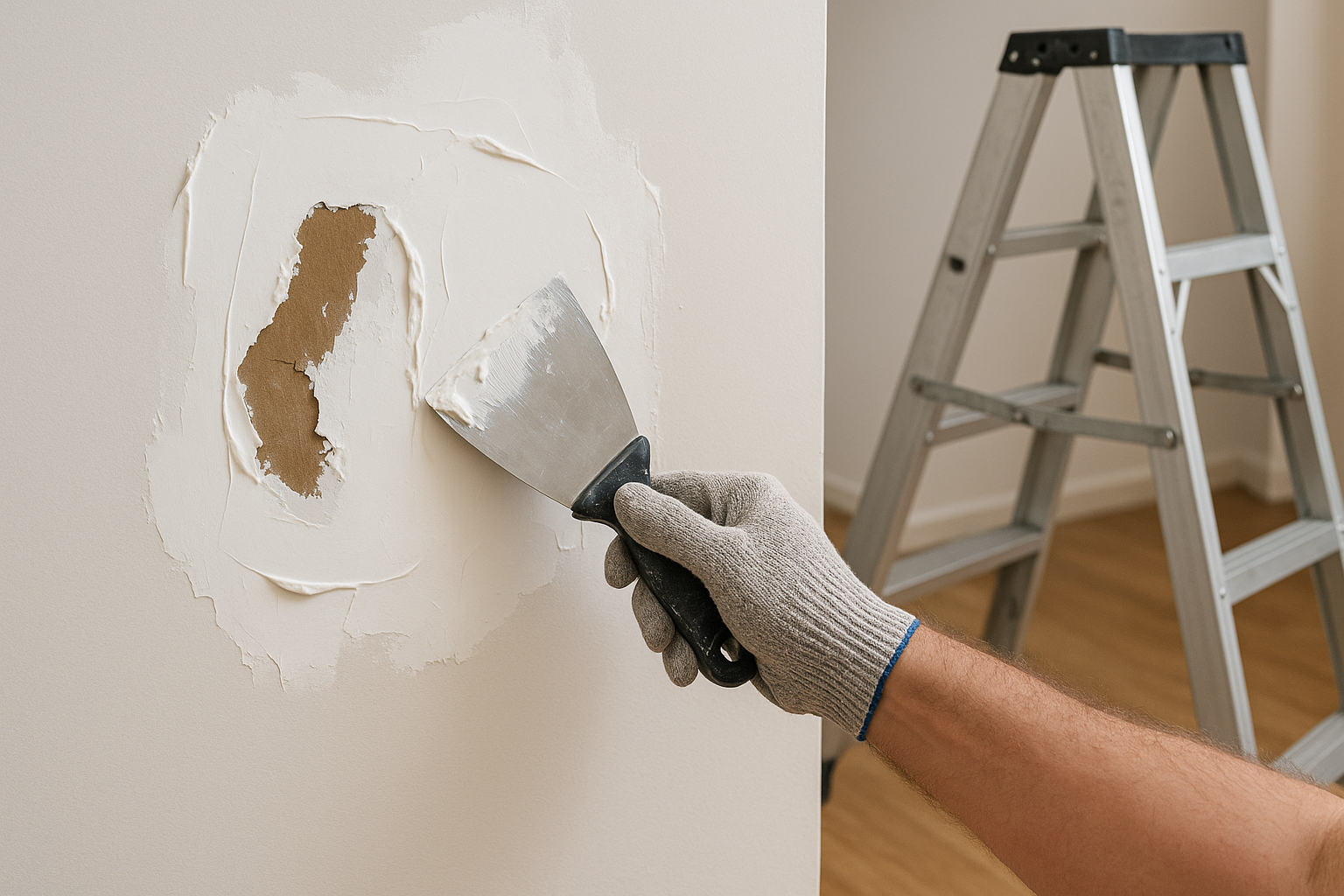
We all want the job done fast. So, it is super tempting to just load up your trowel and slather an inch of mud over the damaged area to fill the hole in one go. Here is the problem with that approach: drywall mud shrinks considerably as it dries.
If you put it on too thick, it cracks, it bubbles, and it takes an eternity to dry completely. You need to apply thin, deliberate coats. Yes, doing three or four thin coats takes more time, but the final results are actually flat.
| Mud Type | Best Used For | Approximate Drying Time |
|---|---|---|
| Hot Mud (Setting-Type) | Deep holes and mesh tape | 20 to 90 minutes |
| All-Purpose Compound | Embedding paper tape | 24 hours |
| Lightweight Topping | Final thin coats and sanding | 12 to 24 hours |
Mistake 4: Sanding Like You Are Grinding Metal
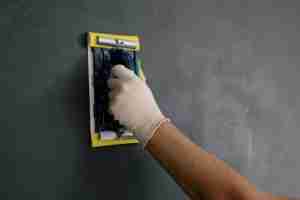
Sanding is where most sheetrock repair projects go totally off the rails. You finally get the wall looking somewhat flat, and then you grab a heavy grit piece of sandpaper and go to town.
You know what happens next? You sand right through the dried mud and tear up the protective paper surface of the drywall itself. That fuzzy, ripped paper texture will show up glaringly obvious once you paint over it. It absorbs paint differently and leaves a rough patch. Use a fine grit sanding sponge—around 120 or 150 grit—and use a light, gentle, circular motion. Let the paper do the heavy lifting, not your shoulder muscles.
Mistake 5: Ignoring Why the Damage Happened
Sometimes a hole is just a hole. Maybe the kids got a little too wild playing hallway hockey. But other times, that bubbling paint or crumbling drywall is trying to tell you something incredibly important about your house.
Are you just Patching over a spreading water stain? If you do not fix the leaky roof or the dripping plumbing pipe behind the wall first, your beautiful new Drywall Repair will be ruined in a matter of weeks. The same rule goes for foundation settling, which happens constantly in older Davis County neighborhoods. Fix the root cause first, then fix the wall.
Mistake 6: Using the Wrong Tools for the Job
Trying to patch a medium-sized hole with a flimsy, two-inch plastic putty knife is exactly like trying to shovel a snowy driveway with a soup spoon. You just cannot get a wide, feathered edge with a tiny tool.
If you want your wall repair techniques to look truly professional, you need the right gear in your hands.
- A 4-inch or 6-inch taping knife: Perfect for applying that crucial first layer of mud and bedding the tape securely.
- A 10-inch or 12-inch finishing knife: Absolutely essential for feathering the edges out wide so the patch blends invisibly into the surrounding wall.
- A proper metal mud pan: Scooping mud straight out of the plastic bucket with your knife just gets messy and dries out the remaining compound prematurely.
Mistake 7: Forgetting the Magic Primer Step
You finished sanding. The wall feels as smooth as glass under your hand. You are exhausted, so you just grab a roller and slap some leftover wall paint directly over the dusty patch.
Big mistake. Joint compound is incredibly porous. It sucks up the moisture from the paint like a dry sponge, leaving a dull, flat spot that stands out every single time the hallway light hits it. Industry pros call this flashing. You absolutely must use a good drywall primer to seal the mud before you put your colored topcoat on. It adds one extra step to the process, but it prevents the patch from flashing like a neon sign.
Mistake 8: Botching the Texture Match
Unless your house has perfectly flat, museum-quality walls, you are going to have to match the existing texture. Most homes in Utah have some sort of knockdown, orange peel, or skip trowel texture.
Those convenient spray cans of wall texture from the local hardware store seem like a total lifesaver, but they are notoriously finicky. If you spray too close, the texture puddles into a sloppy mess. If you spray too far away, it turns into useless dust before it hits the wall. Always practice on a scrap piece of cardboard first. Better yet, accept that matching texture perfectly is almost an art form that takes years to master.
Mistake 9: Being Impatient With the Drying Time
We get it. Having a messy construction zone right in the middle of your living room is incredibly annoying. But rushing the drying process is a guaranteed way to ruin your hard work.
Even though our famously low humidity here in Utah helps things dry a bit faster, you still cannot rush science. If you put a second coat of mud over a first coat that is still slightly damp underneath, the trapped moisture has nowhere to go. Eventually, the whole patch might peel, bubble, or crumble right off the wall. Just wait the full 24 hours between regular coats. Honestly, patience is the cheapest tool in your toolbox.
Mistake 10: Assuming It Is Always a Quick Weekend DIY
There is a certain undeniable pride in fixing up your own home. But sometimes, what looks like a simple Saturday morning project turns into four frustrating trips to the hardware store, three days of agonizing drying time, and a living room covered in chalky white dust.
By the time you buy the proper knives, the metal mud pan, the primer, the texture spray, and the right kind of tape, you might have spent just as much money as you would have by calling local professional Drywall Contractors. Plus, you still have to actually do the tedious manual labor yourself.
Let the Local Pros Handle the Mess
Fixing damaged walls is tedious, surprisingly messy, and requires a lot of patience to get that perfect, completely invisible finish. If you are dealing with a doorknob hole, unexpected water damage, or a cracked Ceiling, you do not have to tackle it alone.
At Utah Drywall & Repair, we take the hassle completely out of the equation. We know exactly how to prep, patch, and texture-match so your walls look exactly like they did before the damage happened. We proudly serve homeowners across Salt Lake County, Davis County, and Utah County with fast, reliable, and practically dust-free service.
Why spend your entire weekend covered in drywall dust when you could be relaxing? Give us a call.