You’ve finally finished Hanging and Mudding a fresh sheet of drywall, and honestly, staring at those chalky taped seams can feel a little intimidating. Whether you are Patching up a Basement in Salt Lake County or Remodeling a master bedroom down in Utah County, getting that flawless, smooth color is what makes a house actually feel like a home. Let me explain exactly how to tackle this final hurdle so your walls look like a seasoned veteran did the heavy lifting.
Contents
Why Bother Priming? (Spoiler: It’s Not a Scam)
Let’s start with the classic DIY dilemma. You are standing in the hardware store paint aisle. You see an expensive can that loudly promises “Paint and Primer in One.” You think, “Great, I’ll save a step and skip the primer.” Here’s the thing: skipping a dedicated primer on fresh drywall is a massive mistake.
Let’s talk about why. New drywall is incredibly porous. The paper facing sucks up moisture like a sponge, and the joint compound (the “mud” covering the Screws and seams) absorbs liquid completely differently than the paper does. If you just slap standard paint directly over this mix of materials, the paint will dry unevenly. You get dull, flat spots right where the mud is, and shiny spots where the paper is. This annoying phenomenon is called “flashing,” and it looks terrible.
To prevent this, you need a PVA primer. PVA stands for polyvinyl acetate—which is basically just carpenter’s glue mixed with water. This stuff is specifically designed to seal the microscopic pores of the drywall and the mud, creating a hard, uniform shell for your topcoat to stick to. It’s cheap, it dries incredibly fast, and you know what? It saves you from having to buy and apply three or four coats of expensive premium paint. A lot of people try to cut corners here, but trust me, priming is the one step you simply cannot skip.
Gear Up: What You Actually Need Before Popping a Lid
Before we crack open any paint cans, let’s talk about your setup. Having the right tools makes a grueling chore feel like a weekend breeze. You do not need the absolute most expensive gear in the store, but getting the right kind of gear is non-negotiable.
| Tool | What It Is | Why You Need It |
|---|---|---|
| PVA Primer | A specialized drywall sealer | Seals porous joint compound and paper so paint applies evenly. |
| 1/2-inch Nap Roller | The fuzzy part of your paint roller | Holds plenty of paint for smooth drywall without leaving weird lines. |
| High-Quality Angled Brush | A 2.5-inch nylon/polyester brush | Perfect for “cutting in” around baseboards, ceilings, and tricky corners. |
You will also want some drop cloths. Canvas is way better than plastic, by the way. Plastic shifts around, and wet paint takes forever to dry on it, meaning you usually end up stepping in it and tracking it onto your carpet. Canvas absorbs the drips.
Also, grab some blue painter’s Tape, a sturdy roller extension pole, and a bright LED work light. The work light is a game-changer. It helps you see every little bump and shadow on the wall before you start Painting. Your future self will thank you for taking the time to gather the right supplies before getting your hands dirty.
Dust, Dry Air, and Prepping the Surface
Let me explain a little secret about professional drywall finishing: 80% of a great paint job is just the prep work. It is tedious. It is boring. But it is entirely necessary to get that pristine look.
If you just finished Sanding your drywall mud, your walls are covered in a fine layer of white dust. Up here in Davis County and across the Wasatch Front, our famously dry air means that fine dust just lingers and floats everywhere. If you paint over drywall dust, your paint will literally just stick to the dust instead of the wall. Later on, it will peel off in frustrating, rubbery sheets.
So, how do we fix this dusty mess?
- Sweep the walls: Take a clean, dry broom and literally sweep your walls from the Ceiling down to the floor. It sounds crazy, but it works.
- Wipe it down: Use a damp—not wet—sponge or a microfiber cloth to wipe up the remaining dust. Give it an hour or two to dry completely.
- Check for imperfections: Run your hand over the seams. If you feel a bump, grab a sanding sponge and smooth it out. The paint will hide absolutely nothing. In fact, paint actually highlights bad mudding.
Once the dust is gone and the floor is protected with your canvas drop cloths, grab a screwdriver. Take off all your electrical outlet covers and switch plates. It takes maybe five minutes, but it saves you from awkwardly trying to cut in around a tiny plastic square. Plus, getting paint on those covers always looks sloppy. Finally, tape off your baseboards, window frames, and trim. Take your time pressing the tape down firmly so the paint does not bleed underneath it.
Slapping on the Primer
Okay, the prep is done. It is time to prime.
First, grab your angled brush and “cut in” the edges. Cutting in just means painting a neat border around the areas where your large roller cannot reach—like the tight corners, along the ceiling edge, and right above the baseboards. You want a border that is roughly three inches wide.
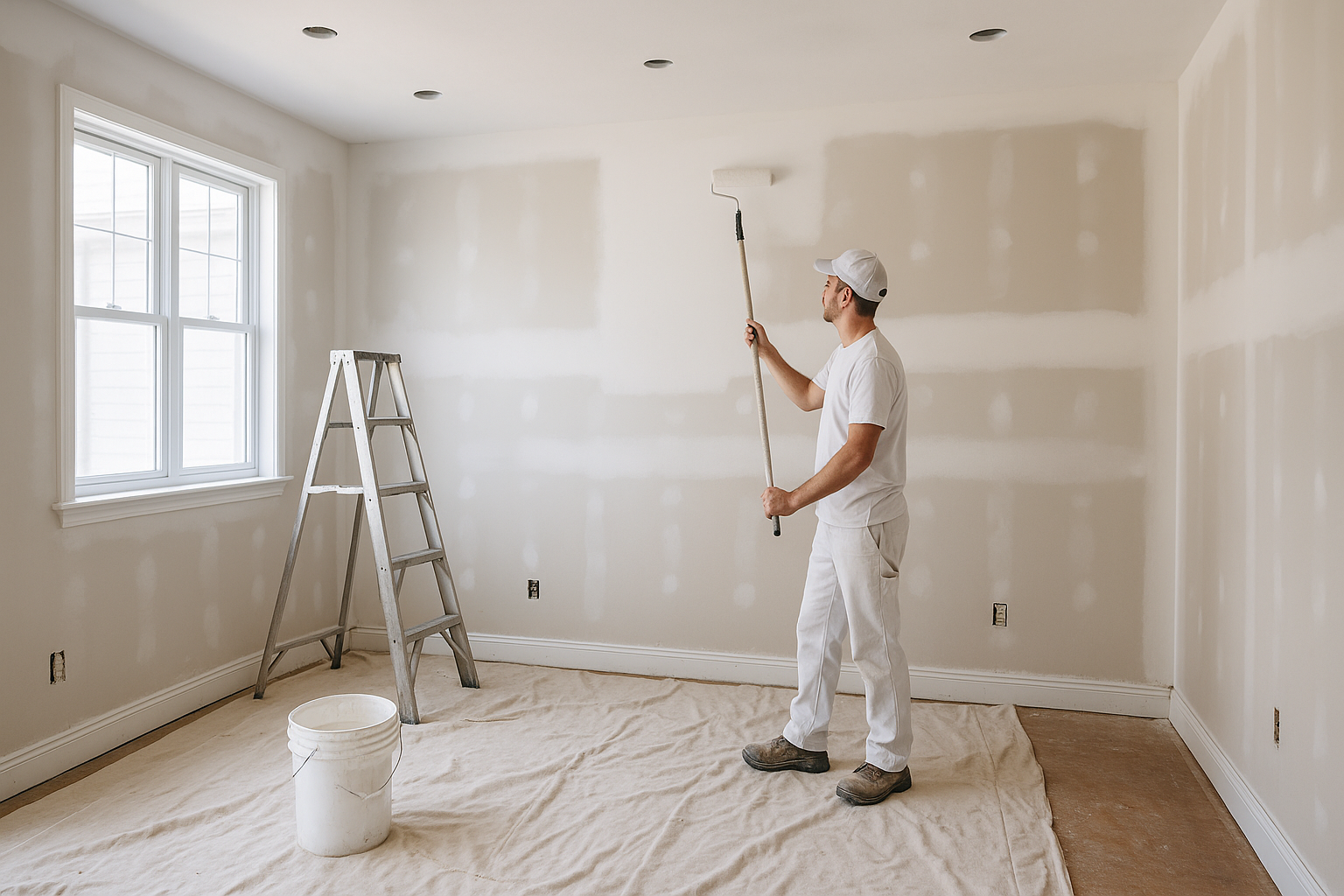
Now, grab your roller. Load it up with PVA primer in your paint tray. You want the roller to be saturated but not dripping heavily everywhere. Start rolling the primer onto the wall in manageable sections.
There is a bit of a debate here among painters. Some folks say to paint in a “W” or “V” pattern to distribute the paint across the wall. But honestly? A lot of modern pros just roll straight up and down, overlapping the previous pass by about 50%. The straight up-and-down method helps prevent weird, diagonal roller marks from showing up when the light hits the wall. Always keep a “wet edge.” This means you always roll into the wet primer you just applied, rather than letting a section dry before moving on to the next.
If you are taking a break between priming and painting, wrap your wet brush tightly in a plastic grocery bag or some cling wrap. It keeps the bristles from drying out while you grab lunch. Primer usually dries pretty quickly, especially in our arid Utah climate. Give it a few hours to set. It won’t look pretty—it might even look a little streaky or chalky—but that is completely fine. It is just a base coat doing its job.
The Main Event: Painting Your Drywall
Once the primer is bone dry, it is time for the fun part: adding actual color to your room.
You will follow the exact same process you used for the primer. Cut in the edges first with a clean brush, then roll the main sections. However, applying the topcoat requires a slightly gentler touch and a bit more attention to detail.
When you are rolling your topcoat, do not press too hard against the wall. If you push hard, you will squeeze paint out of the hard edges of the roller, leaving annoying little tracks—commonly called “fat edges” in the painting world. Just let the roller do the work. If you feel like you have to press hard to get coverage, you simply need to dip your roller back into the tray for more paint.
As you roll, keep that LED work light we talked about earlier shining across the wall at a sharp angle. This casts shadows on any spots you might have missed or any areas where the paint is pooling up. It is way easier to fix a run while the paint is still wet than it is to sand it down after it dries.
Let’s talk quickly about sheen. If your drywall mudding is a little rough, avoid glossy paints. Flat or eggshell finishes absorb light and hide those minor imperfections beautifully. Satin or semi-gloss finishes reflect light, which makes every single bump and dip wildly obvious.
Most freshly primed drywall requires two solid coats of topcoat paint. Apply the first coat, let it dry entirely according to the manufacturer’s instructions, and then hit it with a second coat. That second coat is exactly where the magic happens. The color deepens, the sheen evens out, and suddenly, your rough construction zone looks like a professionally finished space.
Knowing When to Pass the Roller
Look, DIY home improvement projects can be incredibly rewarding. There is a very real sense of pride that comes from standing in a room you fixed up with your own two hands. But sometimes, things just do not go as planned.
Maybe your mudding did not turn out quite right, and you need someone to fix those uneven taped seams before you can even think about painting. Maybe you are dealing with a massive vaulted ceiling in Salt Lake County that makes your head spin just looking up at it. Or maybe, you simply do not have the free time to spend your entire weekend covered in drywall dust, primer, and blue tape.
It happens to the best of us. And there is absolutely zero shame in calling in the experts to handle the heavy lifting. Professional drywall finishing is a tricky art form, and sometimes bringing in a dedicated crew is the absolute quickest way to get your home back to normal. At Utah Drywall & Repair, we know exactly how to handle Utah’s unique climate, tricky wall textures, and everything in between to give you a truly flawless finish.
Ready to hand over the paintbrush and save your weekend? Let us help you get the perfectly smooth walls you actually want.