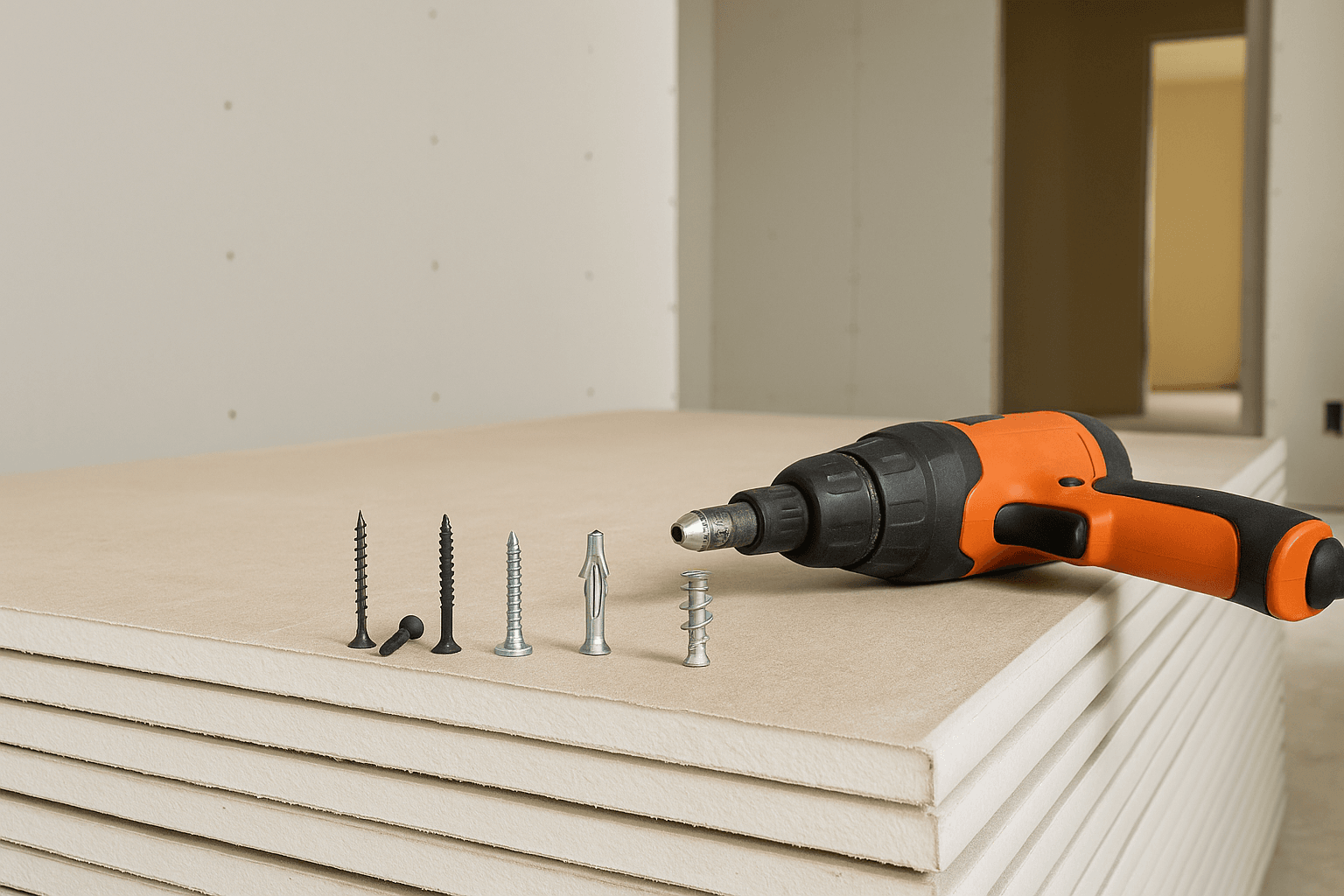
Ever stood in the hardware aisle at Home Depot, staring at a wall of boxes, wondering why on earth there are fifty different types of Screws for one simple job? It happens to the best of us. Hanging drywall seems straightforward enough—put the sheet up, shoot a fastener in, and you’re done—but the hardware you choose actually makes or breaks the finish.
Contents
The Great Debate: Nails vs. Screws
You know, back in the day, drywall nails were the standard. If you walk into a home built in Sandy or Bountiful in the 1970s, you’ll probably find the walls were hung with nails. But things have changed. While you can still use nails, most professionals have moved on.
Here’s the thing: nails pop.
Wood studs shrink and twist as they dry out over time—especially in our dry Utah climate. When the wood moves, a smooth-shank nail loses its grip, and suddenly you have a little round bump pushing through your paint. It’s annoying.
If you absolutely insist on using nails, use ring-shank nails. They have little ridges on the shaft that bite into the wood much better than the old smooth ones. But honestly? Just grab a box of screws. They hold tighter, they don’t pop as easily, and if you mess up, you can back them out without destroying the sheet.
Decoding the Screw Box: Threads and Lengths
Okay, so you’ve decided to use screws. Good call. But now you have to pick the right one. You’ll see terms like “coarse thread,” “fine thread,” and “self-drilling.” It sounds like a lot of jargon, but it’s actually pretty simple logic.
It all comes down to what is behind the drywall.
Coarse Thread (The Wood Grabber)
If you are framing a Basement in Draper or renovating a bedroom with standard wood studs, you want coarse thread drywall screws. These are often referred to as “W-type” screws. The wide threads chew through the wood fibers and pull the drywall tight against the stud. They hold like crazy.
Fine Thread (The Metal Piercer)
In Commercial buildings or some modern basements where metal studs are used, coarse threads won’t work. They’ll just strip the metal. This is where you need fine thread screws (“S-type”). They have more threads per inch, allowing them to grind their way into the steel and hold fast.
Here is a quick breakdown to keep it straight:
| Stud Type | Screw Type | Why? |
|---|---|---|
| Wood Studs | Coarse Thread | Bites into wood fibers quickly; faster driving. |
| Metal Studs | Fine Thread | Chews into steel; coarser threads would strip out. |
| Heavy Gauge Metal | Self-Drilling | Has a drill-bit tip to pierce thick steel framing. |
Does Size Matter? (Yes, It Does)
I see this mistake all the time. A homeowner grabs a box of 3-inch screws thinking, “longer is stronger, right?”
Well, not exactly.
For standard 1/2-inch drywall (which is what is in 99% of homes in Salt Lake and Utah Counties), a 1 1/4-inch screw is the sweet spot. You only need the fastener to penetrate the wood stud by about 5/8 of an inch to 3/4 of an inch.
If you use a screw that is too long, a couple of things happen:
- You waste energy. Driving a long screw takes more battery power and more elbow grease.
- You risk damage. The further that screw goes into the wall cavity, the higher the chance you’ll hit an electrical wire or a plumbing pipe. Trust me, hearing a “hiss” after driving a screw is a sound that will haunt your nightmares.
For 5/8-inch drywall (usually found on ceilings or garage firewalls), bump it up to a 1 5/8-inch screw.
The “Goldilocks” Depth
This is the tricky part. It requires a bit of touch.
When you drive a screw, you want the head to sit just below the surface of the paper, creating a slight dimple that can be filled with joint compound (mud).
- Too Shallow: The screw head sticks out. Your Taping knife will hit it, and you’ll have a bump in the wall.
- Too Deep: This is the most common error. If you drive the screw so deep that it tears through the paper face and crumbles the gypsum, it creates a failure point. The paper is what holds the rock together. Break the paper, and the screw isn’t holding the sheet anymore; it’s just pinning it loosely.
If you are doing this yourself, buy a dimpler bit for your drill. It has a little stopper that prevents you from driving the screw too deep. It’s a lifesaver for beginners.
Hanging Heavy Stuff On Drywall
Alright, let’s shift gears. Maybe you aren’t hanging the drywall sheets; maybe you are just trying to hang a heavy mirror or a new 70-inch TV on a wall that’s already finished.
This is where people get into trouble.
Drywall is essentially chalk sandwiched between paper. It has zero structural integrity for holding weight on its own. If you just drive a screw into the drywall without hitting a stud, gravity will eventually win. You’ll come home to find your shelf on the floor and a jagged hole in the wall.
The Plastic Plug (The “Maybe” Anchor)
You know those little colorful plastic tubes that come with cheap towel racks? They expand slightly when you put a screw in. They are okay for very light loads—like a small picture frame—but honestly? I throw them away. They loosen up over time.
The Toggle Bolt (The Heavy Lifter)
If you can’t hit a stud, use a toggle bolt or a strap toggle. These have metal wings that fold flat to go through a hole, then spring open behind the wall. You tighten the bolt, clamping the drywall between the wings and the bolt head. These can hold massive amounts of weight because they spread the load over a larger area of the backside of the wall.
The Utah Factor: Why Our Climate Matters
You might wonder, “Does living in Salt Lake really change how I screw in a board?”
Actually, yes.
We live in a high desert. Our humidity swings are drastic, and we have four distinct seasons. When a house is framed in the winter or spring, that lumber might have a higher moisture content. As the house settles and the furnace runs through a dry winter, that wood shrinks.
This is why we focus so much on gluing and Screwing. Professional hangers usually apply a bead of construction adhesive to the studs before hanging the sheets. This creates a chemical bond that reduces the stress on the fasteners. If you are doing a repair or a remodel in your basement, adding that glue can save you from developing nail pops (or screw pops) two years down the road.
Moisture Resistant Fasteners
Are you working in a bathroom? Or maybe a laundry room?
Standard screws are usually phosphate-coated (that’s why they are black). They resist rust reasonably well. But for high-moisture areas, or if you are installing cement board for tile, you need specific coated screws meant for that environment.
If you use a regular drywall screw to hang cement board in a shower, the alkali in the cement board will eat the screw, and the moisture will rust it out. Before you know it, your tiles are loose. Look for screws specifically labeled for cement board or exterior usage if you’re working in wet zones.
Tools of the Trade
You don’t need a thousand-dollar setup to drive fasteners, but the right tool helps.
- Impact Driver: Most homeowners have one of these. They work great, but be careful. They have a lot of torque and can snap screws or overdrive them instantly.
- Drywall Screw Gun: This is what we use. It spins at high RPMs but has a lower torque, and it has a depth-sensing nose cone. You can literally keep the motor running and just push it against the wall.
- Tape Measure: Seems obvious, but mark your studs on the floor and Ceiling before you put the sheet up. Once that board is up, you’re guessing where the studs are unless you marked them.
When to DIY and When to Call Us
Hanging drywall is one of those jobs that looks deceptively easy until you’re three sheets in, covered in dust, and realizing your ceiling seam is crooked.
If you are just Patching a hole from a doorknob accident? Grab some screws, a scrap piece of wood, and go for it. You’ve got this.
But if you are finishing a basement, doing a large remodel, or dealing with water damage in your ceiling? That’s where the difficulty ramps up. Getting the fasteners right is just step one. Taping, Mudding, and Sanding to a smooth, invisible finish is an art form that takes years to master.
You don’t want to stare at uneven walls or screw pops for the next ten years. If the project feels bigger than a weekend warrior job, or if you just want it done fast and flawlessly, we’re here to help.
Ready to get your walls looking perfect?
At Utah Drywall & Repair, we handle everything from small patches to full basement finishes across the Wasatch Front. Let us handle the heavy lifting (and the screwing).